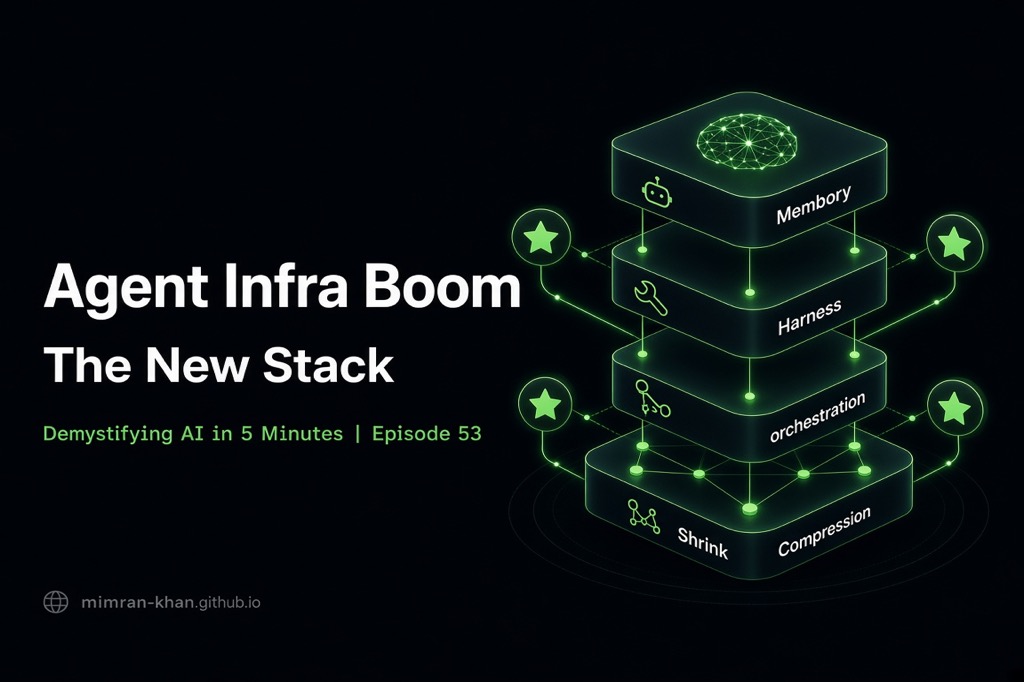
October 2026 GitHub Trending was dominated by agent infrastructure tools. opencode hit 217k stars. ruflo hit 77k. orca hit 98k. These are not AI models. They are the plumbing that makes AI agents actually work: memory layers, harness frameworks, context compressors, and multi-agent orchestrators. The middleware layer nobody planned for is now the hottest layer in the stack.
# The Stack Nobody Planned
Six months ago, the AI stack was simple: model providers on top, your application on bottom. Now there is an entire layer in between, and it is growing faster than either end.
"Agent harness engineering" trended on Hacker News with 126 points. The term did not exist a year ago. Today it describes a new discipline: building the infrastructure that connects AI agents to the real world. Memory systems, context compressors, subscription routers, multi-agent mesh networks. None of this shipped with any foundation model. Developers built it from scratch.
Memory, context compression, model routing, multi-agent orchestration, git wrappers
# The October Trending Lineup
Eight tools on GitHub Trending in October all solving the same fundamental problem: agents are only as good as their infrastructure. Here is what blew up and why.
The biggest project on the list. A fully open-source coding agent that rivals commercial offerings. 217k stars makes it one of the most-starred AI repos of all time. It proves the thesis: the coding agent itself is becoming a commodity. The value is moving to what wraps it.
Run any coding agent with your existing API subscription. One key, any agent. Orca decouples the agent from the model provider, letting you swap between Claude, GPT, Gemini, or local models without reconfiguring anything. The "bring your own key" layer that every agent needed.
Multi-agent swarms with adaptive memory, federation, and vector RAG built in. ruflo treats agent coordination as a first-class problem. Agents share context through a federated memory layer, form dynamic swarms for complex tasks, and use vector retrieval to recall past decisions.
Compress tool outputs 60-95% before sending them to the LLM. Context windows are large but not free. headroom shrinks tool output so your agent can do more in fewer tokens. At 76k stars, context compression is clearly a pain point everyone was feeling.
Switch models per agent from your menu bar. Hot-swap between providers mid-task without restarting the agent session.
Long-term memory for coding agents, written in Rust. Persistent context that survives across sessions, projects, and machines.
Git redesigned for AI agents. Structured diffs, semantic commits, and agent-readable history. The version control layer agents actually need.
P2P mesh between coding agents. Agents discover, negotiate with, and delegate tasks to each other across machines without a central server.
# Why the Middleware Exploded Now
Three forces converged in Q3 2026 to create the infrastructure boom.
GPT, Claude, Gemini, Llama are all "good enough" for coding. When every model can write code, the differentiator is not the model. It is the harness. opencode's 217k stars prove it: people want the best agent experience, not the best raw model.
Bigger context windows did not solve the problem. They just made it more expensive. headroom's 76k stars are the developer community screaming: "We need smarter context, not more context." Compressing tool outputs 60-95% is not a nice-to-have. It is survival.
Single agents hit ceilings. ruflo's 77k stars and reason-network's P2P mesh show the industry moving to swarms, federations, and agent-to-agent collaboration. Once agents talk to each other, you need memory systems, coordination protocols, and shared context layers. The infrastructure demand compounds.
# The Emerging Pattern
Look at these eight tools together and a pattern emerges. The agent infrastructure stack is splitting into five clear categories.
| Category | Tool | Problem Solved | Stars |
|---|---|---|---|
| Memory | ai-memory, ruflo | Persistent and shared context | 88k |
| Compression | headroom | Token cost and context limits | 76k |
| Routing | orca, magpie | Model provider lock-in | 113k |
| Coordination | reason-network | Multi-agent communication | 393 |
| Tooling | git-ai | Agent-native dev workflows | 1.5k |
ai-memory, ruflo
Persistent and shared context
headroom
Token cost and context limits
orca, magpie
Model provider lock-in
reason-network
Multi-agent communication
git-ai
Agent-native dev workflows
Every major infrastructure era follows this pattern. Containers needed Kubernetes. Microservices needed service meshes. AI agents need agent harnesses. The middleware always wins because it owns the integration surface. And right now, the agent middleware surface is wide open.
The AI agent war is not about who builds the best model. It is about who builds the best infrastructure around it. October 2026 proved that with 500k+ combined stars across eight agent infrastructure tools. Memory, compression, routing, coordination, and agent-native tooling are the new battleground. If you are building agents without thinking about the harness layer, you are building on sand.
Enjoyed this?
New episodes Mon, Wed, Sat.