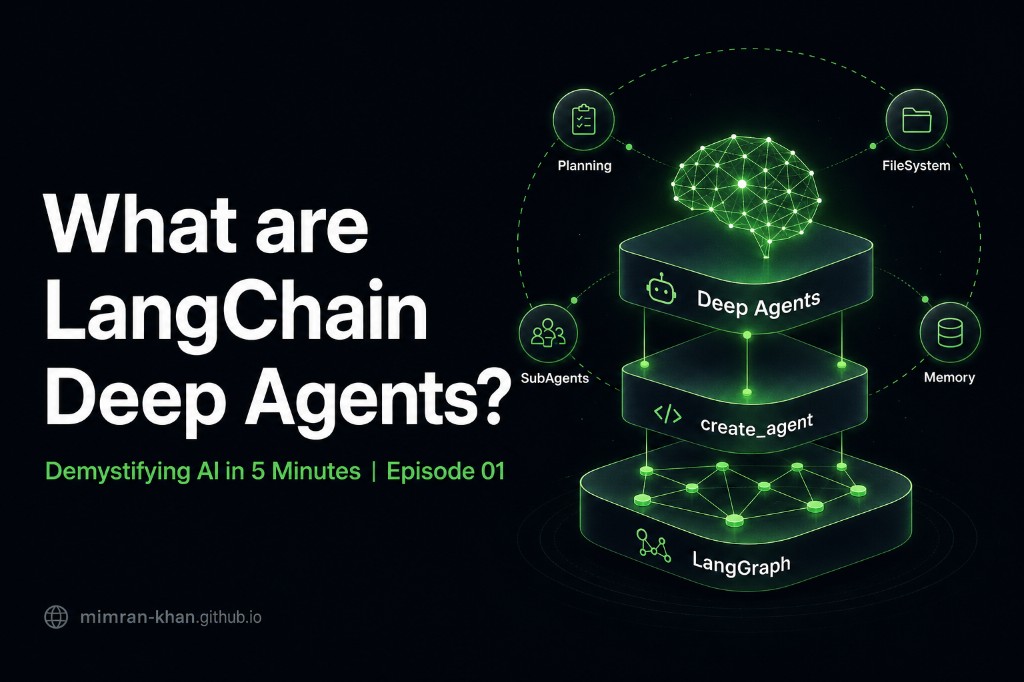
Deep Agents = LangGraph + planning + file system + sub-agents + memory. One create_deep_agent() call. Production-ready out of the box.
# Shallow vs Deep
Claude Code, Manus, and Deep Research all use this pattern. Deep Agents packages it into a library.
# The 3-Layer Stack
Not a replacement for LangGraph. A layer on top. All three compose.
Deep Agents
Full harness. Planning + FS + sub-agents + memory. Start here.
create_agent
Minimal ReAct loop. Model + tools = working agent.
LangGraph
Raw graph runtime. Full control over everything.
# The 4 Superpowers
Auto-injected middleware. You get all four with zero config.
Planning
write_todos tool
Agent creates and checks off tasks. Stays focused across 50+ steps. Same pattern as Claude Code.
Virtual File System
read/write with permissions
Offloads large results. Stores artifacts. Context window never blows up.
Sub-Agents
isolated context workers
Delegate tasks to parallel workers. They run isolated, return results. Parent context stays clean.
Long-term Memory
LangGraph Store
Remembers preferences and decisions across sessions. Gets better with every use.
# .md Files Are the Brain
The real config layer isn't Python or YAML. It's plain markdown.
Change the markdown, change the agent. No redeployment. No code changes. Just edit a file.
Key insight: If you can write a README, you can program a production agent. The .md files are the agent.
# 5 Lines to Start
Everything else is handled by the harness.
from deepagents import create_deep_agent
from langchain_openai import ChatOpenAI

agent = create_deep_agent(
    model=ChatOpenAI(model="gpt-4o"),
    tools=[web_search, code_executor],
    system_prompt="You are a research expert.",
)

# Planning, file system, sub-agents, memory - all built in.
result = await agent.ainvoke({
    "messages": [{"role": "user", "content": "Research quantum computing breakthroughs in 2026"}]
})
# Pick Your Layer
Start at the top. Drop down only when needed.
| You need... | Use this |
|---|---|
| Quick chatbot, single tool | create_agent |
| Research, code gen, multi-step work | Deep Agents |
| Custom control flow, complex branching | LangGraph |
| Both: harness + custom sub-graph | Compose them |
Deep Agents is what happens when you package the Claude Code architecture into a library. Planning, file system, sub-agents, memory. One pip install. If you're building anything beyond a wrapper, this is your starting point in 2026.
Is Grep All You Need? Agent Harness Paper
Grep beats vector search inside AI agents. The results broke everyone's assumptions.
ReadEnjoyed this?
New episodes Mon, Wed, Sat.