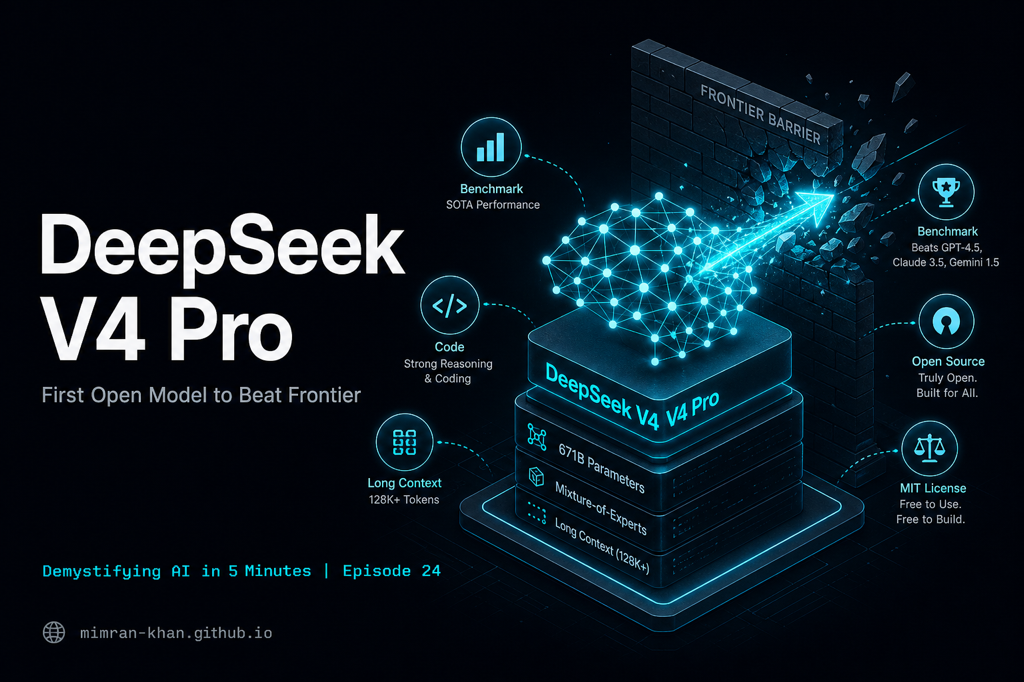
DeepSeek-V4-Pro scores 87.9% on Terminal-Bench 2.1 - beating Claude Opus 4.8 (85.0%). First open-weight model to top a frontier closed model on a major benchmark. 1.6T total params, 49B active via MoE. MIT licensed. $0.87/M output tokens vs Opus 4.8 at $25/M. 72.4 tok/s. 1M context window. The cost-performance frontier just shifted permanently.
# The Benchmark That Matters
Terminal-Bench 2.1 measures real terminal coding workflows - not toy puzzles. Multi-file refactors, debugging sessions, build system configurations, deployment scripts. The tasks professionals actually do. And an open-weight model just took the crown.
- ✓ Terminal workflows - multi-step coding in real shells
- ✓ Live competitive coding - fresh problems, no contamination
- ✓ PR-level bug fixes - real GitHub issues, real codebases
- ✗ Complex multi-constraint instructions - still behind Opus
- ✗ SWE-bench Pro - harder subset, 55.4% vs 69.2%
- ✗ Broad reasoning - CAISI says ~8 months behind US frontier
# The Economics Are Absurd
Beating frontier on benchmarks is impressive. Doing it at 29x lower cost while running 30% faster is a different kind of disruption entirely.
Monthly cost for 100 devs, 50K tokens/day each:
  Claude Opus 4.8:   $3,750,000/month
  DeepSeek V4 Pro:   $  130,500/month

Annual savings:      $43,434,000
  (enough to fund an entire AI research team)

Caveat: Aug 16 price hike (+264% from preview pricing)
  Still 29x cheaper than Opus, but the free lunch ended fast
# The Architecture: 1.6T Params, 49B Active
DeepSeek-V4-Pro uses Mixture of Experts (MoE) - the same architectural pattern that lets it punch above its weight class. Only 49B parameters activate per token. The rest sit idle, contributing knowledge without compute cost.
V4 Pro ships with DSpark - a speculative decoding module that drafts multiple tokens ahead using a smaller model, then verifies them in parallel with the full model. This is why time-to-first-token is 1.77s vs 30.22s for Opus. The speed difference is not incremental - it fundamentally changes how interactive coding feels.
# What This Actually Means
The "open models are always behind closed ones" narrative is dead. Not dying - dead. An MIT-licensed model just beat the most expensive closed model on a real-world coding benchmark.
Route terminal/coding tasks to V4 Pro at $0.87/M. Reserve Opus for multi-constraint reasoning where it still leads. Most enterprise coding workloads just got 29x cheaper with no quality loss.
No usage reporting. No restrictive clauses. Fine-tune it, distill it, deploy it on-prem, sell products built on it. The weights are yours. Unlike Llama's "community license" or Gemma's "responsible use" restrictions - this is actual open source.
Independent CAISI evaluation shows V4 Pro trails the latest US frontier by approximately 8 months on broad reasoning. It dominates coding. It does not dominate everything. Know the boundaries.
DeepSeek-V4-Pro is not "almost as good as closed models." On terminal and coding tasks, it is better. First open-weight model to beat frontier on a major benchmark. MIT licensed. 29x cheaper. 17x faster to first token. The argument that open-weight models cannot compete at the top just became indefensible. The smart move now is not "pick one" - it is route by task, benchmark by use case, and stop paying frontier prices for work that open models do better.
Enjoyed this?
New episodes Mon, Wed, Sat.