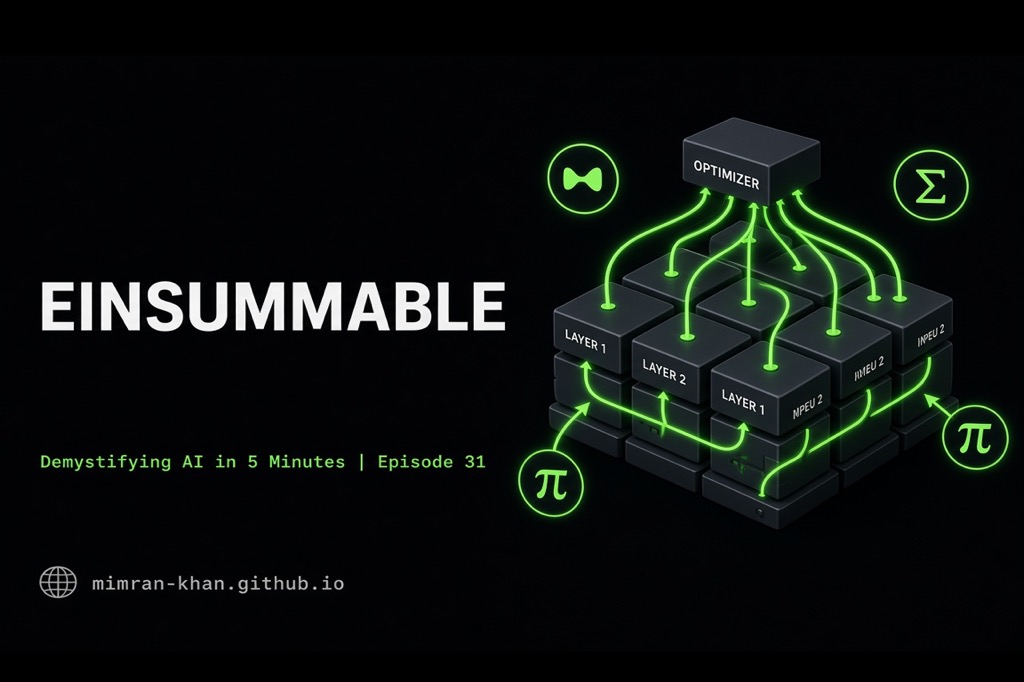
Write PyTorch. Get optimal multi-GPU sharding. Zero annotations. Zero device assignments. Zero communication code. Einsummable models every GPU operation as a relational join and finds decomposition plans that hand-tuned experts miss. 8.97 ms vs 13.80 ms (PyTorch) on LLaMA blocks.
# The Problem It Kills
Multi-GPU parallelism today requires PhD-level expertise. You need to understand tensor parallelism, pipeline parallelism, data parallelism, FSDP configurations, and the subtle ways they interact. Most teams spend weeks tuning sharding strategies that a compiler should handle.
Current auto-parallelizers (Megatron, Alpa, Unity) choose from a menu of named strategies: tensor parallelism, pipeline parallelism, data parallelism. Einsummable does not pick from a menu. It searches the full space of possible decompositions and discovers plans those tools structurally cannot find.
# How It Works: Joins, Not Strategies
The core insight is radical. Every tensor operation is a relational join followed by an aggregation. Matrix multiply, convolution, attention, normalization. All of them. Once you model operations this way, the parallelism problem becomes a database query optimization problem.
Accept a PyTorch-like description of the AI computation. No annotations, no device maps, no sharding specs. Just the math your model needs to compute.
Each operation is modeled as a relational join + aggregation over tensor relations. Tuples contain sub-tensors. Each operation exposes all possible decompositions through "join-agg specs." This is where named strategies become irrelevant.
The optimizer selects decompositions across the whole computation graph to minimize a communication-cost proxy. It does not choose between TP, PP, and DP. It searches the complete space and finds hybrid plans that mesh-based auto-parallelizers cannot express.
Instead of calling AllReduce or AllGather, Einsummable synthesizes custom exchange programs at compile time. These are topology-aware generalizations of Volcano's exchange operator. Every byte of communication is purpose-built for the specific computation and hardware layout.
Faster than hand-tuned code. The compiled plan runs across all GPUs with zero programmer intervention. On 8x A100: 8.97 ms geometric mean on LLaMA transformer blocks.
# The Benchmarks
Tested on an 8-GPU A100 server running LLaMA transformer blocks. A fully automatic system beats the humans who wrote the manual code.
A fully automatic system, with zero human guidance, produced a faster execution plan than expert engineers who manually tuned the parallelism. The compiler did not match human performance. It exceeded it. By 35%.
# What Makes It Different
Einsummable is not an incremental improvement on existing auto-parallelizers. It rethinks the problem from first principles. 4 architectural choices separate it from everything else.
Einsummable invokes zero standard collectives. No AllReduce. No AllGather. No ReduceScatter. All communication is special-purpose, derived at compile time for the specific computation graph.
Exchange programs adapt to the actual GPU interconnect topology. NVLink bandwidth, PCIe bottlenecks, NUMA boundaries. The communication plan is physically optimal, not just logically correct.
Tensors are treated as relations. Operations become joins. This reframing exposes decomposition possibilities that tensor-centric frameworks cannot see. Decades of relational query optimization apply directly.
No device maps. No sharding specs. No @parallelize decorators. No mesh definitions. The programmer writes single-device PyTorch. Everything else is the compiler's problem.
| System | Search Space | Collectives | Annotations |
|---|---|---|---|
| Einsummable | All decompositions | Synthesized | None |
| Megatron-LM | TP + PP + DP | Canned | Manual |
| Alpa | Intra + inter-op | Canned | Minimal |
| FSDP / DeepSpeed | DP + sharding stages | Canned | Config-heavy |
The database community solved query optimization decades ago by searching decomposition spaces instead of choosing from named strategies. Einsummable applies that same principle to GPU parallelism. The result: plans that named-strategy tools cannot even represent, let alone discover.
Einsummable is the strongest evidence yet that manual multi-GPU parallelism is a solvable compiler problem, not an engineering art. It beat hand-tuned PyTorch by 35% with zero human guidance. It beat vLLM by 44%. The sharding annotations you wrote last month? A compiler can do better. The AllReduce calls you carefully placed? A compiler can synthesize something faster. The 10 authors behind this paper (Zhimin Ding + 9 others) have shown that the right abstraction eliminates the problem entirely.
Pace the Frontier: When the Builders Say Stop
Three AI labs agree advancement needs brakes.
ReadEnjoyed this?
New episodes Mon, Wed, Sat.