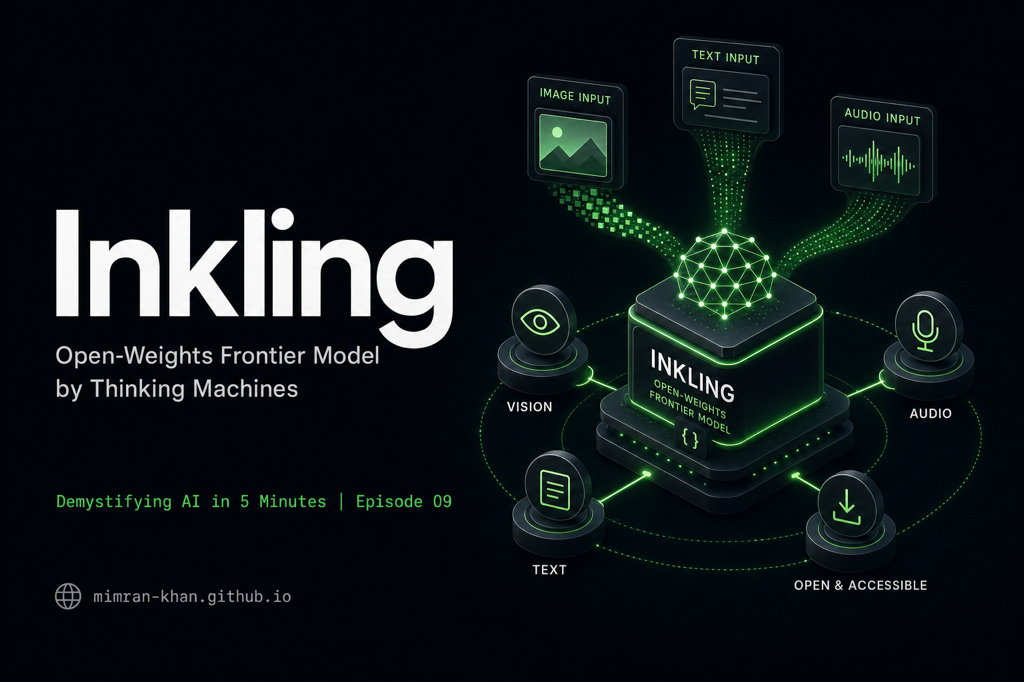
Former OpenAI CTO Mira Murati shipped Inkling - a 975B parameter MoE model with only 41B active per token. Natively multimodal through encoder-free early fusion. 1M context. Licensed under Apache 2.0 with zero restrictions. It does not win every benchmark. That is the entire strategy - the most customizable model wins, not the most capable one.
# The Exit That Built a Model
Mira Murati spent years as OpenAI's CTO watching the company drift from "open" to "closed." The non-profit mission that attracted the founding team was sidelined in favor of multi-billion-dollar licensing deals, capped-profit structures, and an API moat. She was CTO of a company that no longer aligned with her vision.
So she left. Not to retire. Not to advise. To build exactly what OpenAI refused to ship.
Murati leaves OpenAI
After years as CTO, she walked away from the company she helped build. The departure came during a period of mass executive exits at OpenAI.
Founds Thinking Machines Lab
Co-founded with John Schulman (OpenAI co-founder, inventor of PPO) and Barret Zoph (created Neural Architecture Search at Google Brain). This is not a startup. This is an all-star team.
$2B seed round - largest AI seed ever
Led by a16z at a $12B valuation before shipping a single model. The bet was on the team, not the product. Murati publicly committed to "a significant open source component."
Inkling ships - the promise delivered
975B-parameter frontier model. Apache 2.0. No strings attached. The "significant open source component" Murati promised in 2025 is now real.
Former CTO of OpenAI. Shipped GPT-4, DALL-E, and ChatGPT. The most impactful AI product launches in history.
OpenAI co-founder. Invented PPO - the RL algorithm that made RLHF practical. Without PPO, ChatGPT does not exist.
Created Neural Architecture Search at Google Brain. Led scaling research at OpenAI.
The bet: The future of enterprise AI is not raw capability. It is customization. Build the strongest open foundation, let everyone fine-tune it for their domain.
# The Numbers
975B total, 41B active. Mixture-of-Experts routing means you get frontier-scale knowledge at mid-range inference cost. Only a fraction of the network fires per token.
Encoder-free early fusion. Text, images, audio, and video processed through a single transformer from day one. No adapters. No modality gap.
BENCHMARKS vs OPEN WEIGHTS
Inkling competes against 2 categories: open-weights models (downloadable, self-hostable) and closed models (API-only). The positioning is very different against each.
| Benchmark | Inkling | Best Open | Best Closed |
|---|---|---|---|
| SWE-bench Pro | 77.6% | Nemotron 3 Ultra: 71.9% | - |
| AIME 2026 | 97.1% | GLM 5.2: 99.2% | Claude Fable 5: 99.9% |
| HLE (text only) | 29.7% | GLM 5.2: 40.1% | Claude Fable 5: 53.3% |
| HLE (with tools) | 46.0% | Kimi K2.6: 54.0% | Claude Fable 5: 64.5% |
| VoiceBench | 91.4% | - | Gemini 3.1 Pro: 94.4% |
Inkling does not win a single benchmark outright against closed models. It wins the one that matters most for developers: SWE-bench Pro at 77.6%, beating every open-weights competitor including Nemotron 3 Ultra. For coding agents and developer tooling, Inkling is the strongest open foundation available.
Honest positioning: Thinking Machines explicitly says "Inkling is not the strongest overall model available today." On HLE and AIME, GLM 5.2 and Claude Fable 5 outperform it. On VoiceBench, Gemini 3.1 Pro leads. The goal is customization, not leaderboard crowns.
# Encoder-Free Early Fusion
Most multimodal models are Frankenstein architectures. Take a text model. Bolt on a CLIP encoder for vision. Add Whisper for audio. Connect them with adapter layers trained after the fact. The result works, but the modalities never truly understand each other.
Inkling takes a different approach. Text, images, and audio enter the same transformer from day one. No encoders. No adapters. No modality gap.
Each modality processed separately, then merged. The transformer never sees raw pixels or waveforms.
All modalities enter the same model from the start of pre-training. Native cross-modal reasoning.
When vision and text live in separate encoders, the model "translates" between them. With early fusion, it reasons across modalities in the same latent space. Ask about a chart, and it reasons about numbers and visual layout simultaneously.
Adjust reasoning depth per request. Lower effort = faster and cheaper. Higher effort = better answers. Developers choose the tradeoff at inference time, not at training time.
Training scale: 45 trillion tokens spanning text, images, audio, and video. The model saw all 4 modalities during pre-training - not as a fine-tuning afterthought, but as the core training signal.
# The Apache 2.0 Bet
Most "open" models are not actually open. Llama has a revenue cap. Gemma has use restrictions. Inkling ships under Apache 2.0 - a real open-source license, not a marketing term.
The license choice is deliberate. Apache 2.0 was picked over MIT and custom licenses for 3 specific reasons.
Apache 2.0 includes an explicit patent grant. MIT does not. Patents on MoE routing or early fusion techniques cannot be weaponized against users.
Fortune 500 legal teams already have pre-approved Apache 2.0. Novel licenses like Llama's require review cycles that can take months.
Unlike GPL/AGPL, Apache 2.0 has no contribution-back requirement. Fine-tune into a proprietary product, keep the weights private.
LICENSE COMPARISON
Build a commercial product with 1 billion users. Llama is blocked above 700M MAU. Inkling has no cap.
Fine-tune for defense or military applications. Llama's acceptable use policy blocks this. Apache 2.0 does not restrict use cases.
Redistribute modified weights freely. Llama requires attribution and license inclusion. Apache 2.0 requires preserving the license notice but imposes no branding or attribution requirements on the product.
Deploy on-premise behind an air gap. No phone-home, no usage tracking, no API dependency.
"Inkling is not the strongest model available." That admission is the entire strategy. OpenAI proved that the strongest model captures developers. Meta proved that the most available model captures researchers. Murati is betting that the most customizable model captures enterprises. The base model is free. The fine-tuning platform is paid. Adoption drives revenue.
# Try It
Three paths: download the open weights for self-hosting, use the Tinker API for managed inference and fine-tuning, or start with the smaller Inkling-Small for lighter deployments.
Full open weights. Apache 2.0. Download and self-host. Up to 1M context with open weights.
Managed inference + full fine-tuning platform. Upload data, configure training, get a custom model. 64K and 256K context tiers.
Company site. Research papers, blog, technical reports, and team info.
Tinker is not just API access. It is a full fine-tuning platform. Upload your dataset, configure training hyperparameters, and get back a custom model fine-tuned on your domain data. This is the business model: open weights are free, fine-tuning infrastructure is paid.
50% launch discount currently active. See Tinker documentation for per-token pricing.
276B total, 12B active. A preview companion model that matches or exceeds Inkling on many benchmarks. How? Improvements to pre-training data and the training recipe. The smaller model benefits from every lesson learned training the bigger one.
Quantized for NVIDIA Blackwell. 4-bit floating point checkpoint for next-gen hardware. Combined with controllable thinking effort, this gives teams a cost-performance dial they can tune per request.
QUICK START
from transformers import AutoModelForCausalLM, AutoTokenizer

model = AutoModelForCausalLM.from_pretrained(
    "thinkingmachines/Inkling",
    device_map="auto",
    torch_dtype="auto",
)
tokenizer = AutoTokenizer.from_pretrained("thinkingmachines/Inkling")

messages = [{"role": "user", "content": "Explain MoE routing"}]
inputs = tokenizer.apply_chat_template(messages, return_tensors="pt")

# 975B total params, only 41B active per token
output = model.generate(inputs, max_new_tokens=512)
print(tokenizer.decode(output[0]))
The strongest model wins benchmarks. The most open model wins adoption. Murati is betting on adoption. Inkling is 975B parameters of "do whatever you want with this" - Apache 2.0 with patent protection, no revenue caps, no use restrictions. Encoder-free early fusion means native multimodal reasoning without bolted-on adapters. Controllable thinking effort means developers choose the cost-quality tradeoff. And the Tinker platform turns fine-tuning from a research project into a product. If enterprise AI is heading toward customization over prompting, the most customizable foundation wins. That is Inkling.
Enjoyed this?
New episodes Mon, Wed, Sat.