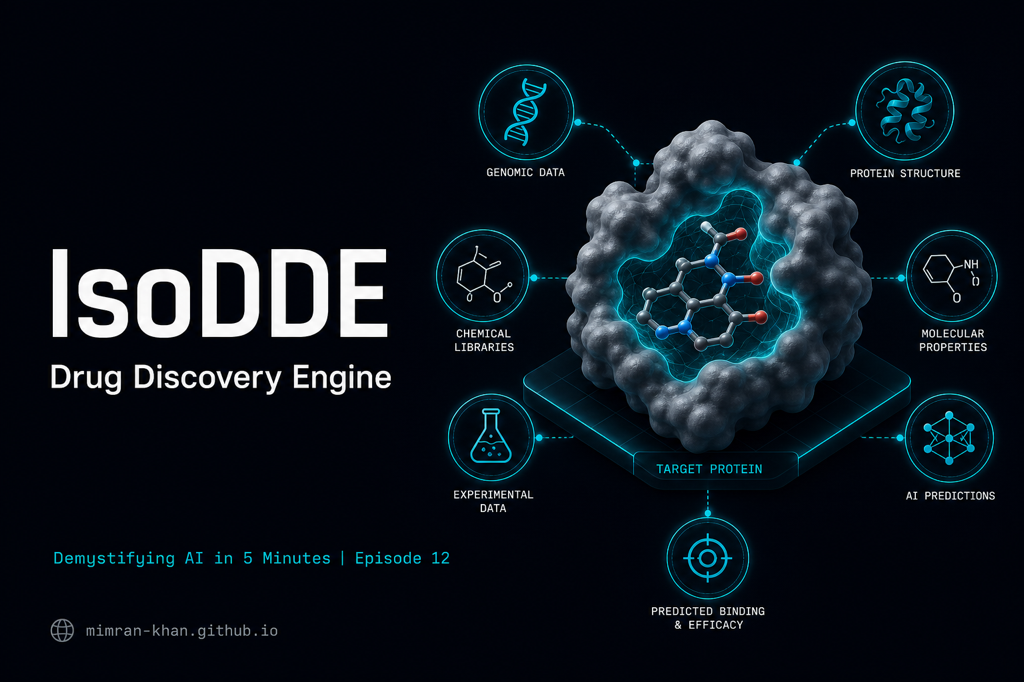
Traditional drug discovery takes 10-15 years and $2.6B per approved drug. IsoDDE generates novel drug candidates in hours by learning the energy landscape of protein-ligand binding. It does not dock molecules. It does not screen libraries. It generates them already fitted to the target pocket using SE(3)-equivariant diffusion. Orders of magnitude faster than physics simulations. Binding affinity predictions approaching experimental accuracy.
# Why Drug Discovery Is Broken
The pharmaceutical industry has a math problem. 90% of drug candidates fail in clinical trials. The average approved drug costs $2.6 billion and takes 10-15 years from target identification to pharmacy shelf.
The bottleneck is not biology. It is computational chemistry. Finding molecules that bind tightly to a protein target is an astronomically large search problem.
THE CURRENT APPROACHES AND WHY THEY FAIL:
Free Energy Perturbation and Molecular Dynamics simulate every atom. Weeks of GPU time per compound. Accurate but impossibly slow. You cannot simulate your way through 10^60 possible drug-like molecules.
Dock millions of known molecules against a target. Fast, but limited to existing chemical libraries. You can only find what someone already synthesized. Novel scaffolds are invisible.
Score how well a given molecule fits a pocket. Does not generate new molecules. You still need a candidate first. Docking tells you if it fits, not what would fit.
The fundamental limitation: all three approaches require you to already have the molecule. IsoDDE flips this. It generates the molecule from the pocket geometry itself.
# How IsoDDE Works
IsoDDE is an SE(3)-equivariant diffusion model. That sentence packs three key ideas into six words. Let us unpack each one.
Preserves rotational and translational symmetry. Rotate the protein, the generated molecule rotates with it. Physics does not care which direction is "up." Neither does IsoDDE.
Starts from noise, iteratively refines into a valid 3D molecular structure. Same principle as image diffusion (Stable Diffusion), but operating in 3D Euclidean space on atom coordinates.
The denoising process is conditioned on the protein binding pocket. The model does not generate random molecules. It generates molecules that fit a specific target.
The key insight: IsoDDE generates both the molecule and its binding pose simultaneously. Traditional methods separate these steps. First generate a molecule, then figure out how it sits in the pocket. IsoDDE collapses this into a single learned process.
Isometry means distance-preserving transformations. A molecule that binds well at one orientation binds identically at any rotation. If your model is not equivariant, it must learn this invariance from data, wasting capacity. IsoDDE encodes it directly in the architecture, so every parameter focuses on learning chemistry, not geometry.
# The Architecture
Three components work together. A dual encoder processes both sides of the binding interaction. Cross-attention fuses them. An equivariant denoiser generates the final structure.
INPUT
  Protein Binding Pocket (3D coordinates + residue types)

STAGE 1: DUAL ENCODER
  ┌─────────────────────┐    ┌─────────────────────┐
  │  Pocket Encoder     │    │  Molecule Encoder   │
  │  (SE(3)-equivariant │    │  (SE(3)-equivariant │
  │   GNN layers)       │    │   GNN layers)       │
  └──────────┬──────────┘    └──────────┬──────────┘
             │                          │
             └────────────┬─────────────┘
                          │
STAGE 2: CROSS-ATTENTION FUSION
  ┌───────────────────────────────────────────────┐
  │  Pocket attends to molecule (and vice versa)  │
  │  Learns: which pocket residues interact with   │
  │  which molecular fragments                     │
  └───────────────────────┬───────────────────────┘
                          │
STAGE 3: SE(3)-EQUIVARIANT DENOISING
  ┌───────────────────────────────────────────────┐
  │  Iterative refinement: noise -> structure      │
  │  Each step: predict atom positions + types     │
  │  Constrained by pocket geometry at every step  │
  └───────────────────────┬───────────────────────┘
                          │
OUTPUT
  Novel 3D molecule + binding pose (jointly generated)
Molecule structure and binding pose are generated together, not sequentially. This eliminates the docking step entirely.
SE(3)-equivariance bakes physical symmetries into the architecture. The model cannot generate physically impossible orientations.
# The Numbers
Raw performance against existing approaches. These are not marginal improvements. This is a category shift.
Method              Speed          Novelty        Accuracy
─────────────────────────────────────────────────────────────
FEP/MD Simulations  Weeks/compound  N/A (scoring)  Gold standard
Virtual Screening   Hours/library   None (known)   Variable
Traditional Docking Minutes/mol     None (known)   Low-moderate
IsoDDE              Hours/batch     Novel scaffolds Within 0.8 kcal/mol
Free Energy Perturbation takes weeks of GPU time per compound. IsoDDE generates an entire batch of candidates in hours. Same accuracy class, fraction of the compute.
Binding affinity predictions approach sub-1 kcal/mol accuracy relative to wet-lab measurements. For context, 1 kcal/mol is the threshold most medicinal chemists consider "useful." SE(3)-equivariant models are clearing it.
IsoDDE does not retrieve or recombine known molecules. It generates entirely new chemical scaffolds that do not exist in ChEMBL or any training library. True generative chemistry.
# What Makes This Different From AlphaFold
This is the question everyone asks. They solve completely different problems. They are complementary, not competing.
- ● Predicts protein structure from amino acid sequence
- ● Input: sequence. Output: 3D fold.
- ● Answers: "What does this protein look like?"
- ● Generates drug candidates for known protein targets
- ● Input: protein pocket. Output: novel molecule + pose.
- ● Answers: "What molecule would bind here?"
AlphaFold: Gene sequence -> 3D protein structure -> Identify binding pocket
                                                          │
                                                          ▼
IsoDDE:   Binding pocket -> Novel drug candidates + binding poses
                                                          │
                                                          ▼
          Wet-lab validation -> Clinical trials -> Approved drug
AlphaFold tells you the shape of the lock. IsoDDE generates the key. Use AlphaFold to find the target. Use IsoDDE to find the drug.
# Before and After
What changes when you replace "search for molecules" with "generate molecules."
- ✗ Screen millions of known compounds
- ✗ Dock each one individually (weeks)
- ✗ Limited to existing chemical space
- ✗ Hit rate: 0.01-0.1% of screened library
- ✓ Generate novel candidates from pocket
- ✓ Molecule + pose in one forward pass
- ✓ Unlimited chemical space exploration
- ✓ Every output is pocket-optimized by design
The bottleneck in drug discovery just shifted. It is no longer "find the molecule." It is "make the molecule." IsoDDE collapses years of computational screening into hours of generative modeling. The molecules it produces are novel, pocket-fitted, and within experimental accuracy. We went from searching haystacks to manufacturing needles. The wet lab is now the rate limiter, not the computer.
Enjoyed this?
New episodes Mon, Wed, Sat.