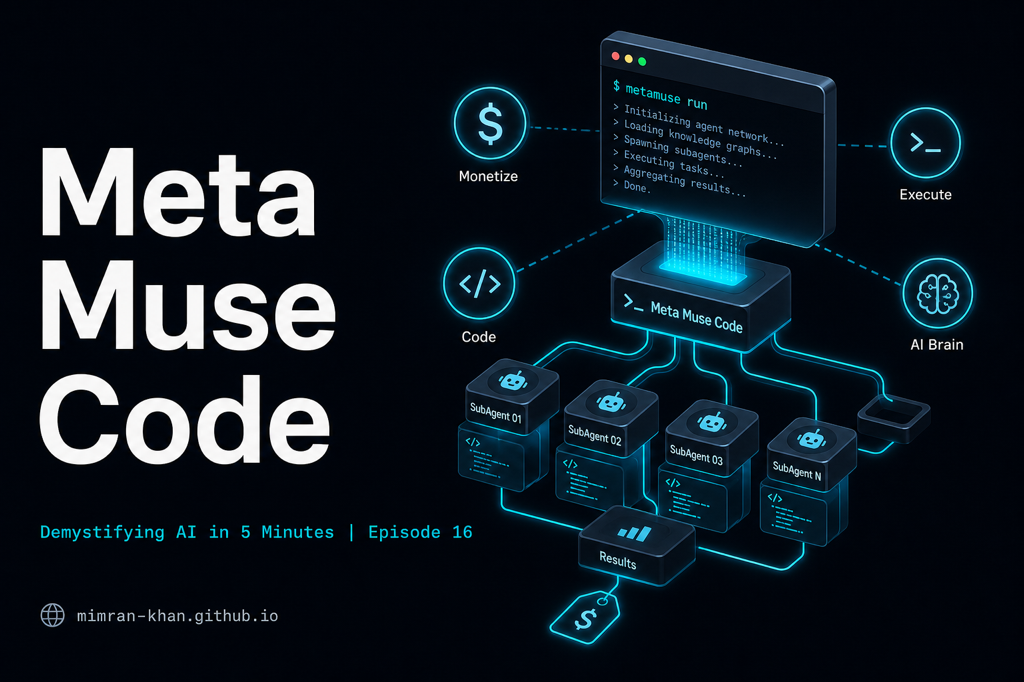
Meta shipped Muse Code on Aug 5, a terminal-only coding agent powered by Muse Spark 1.2. It scores 82.9% on Terminal-Bench 2.1 (vs Claude Opus 5 at 86.7%). The Standard tier runs $1.25/$4.25 per 1M tokens. The Contributor tier runs $0.10/$0.20 - but Meta trains on your traffic. First coding agent with persistent async subagents and crash-safe replay logs. Terminal-only, no IDE plugins.
# Mark Zuckerberg Enters the Chat
Meta has been a spectator in the coding agent race. Claude Code, OpenAI Codex, Grok Build - every major lab shipped a coding agent except Meta. That changed on August 5. Mark Zuckerberg personally announced Muse Code, a terminal-based coding agent that takes on "complete software engineering tasks across large repos."
The pitch is not capabilities. Meta's own benchmarks show Muse Spark 1.2 trails Claude Opus 5 on every test it published. The pitch is price. And architecture.
curl -fsSL https://dev.meta.ai/install.sh | bash
# macOS and Linux only. No Windows. No IDE plugins.
# Run `muse` in any project directory to start.
# Two Tiers: Privacy or Discount
This is where it gets interesting. Meta offers Muse Spark 1.2 in two pricing tiers. Same model, same weights. The difference is what happens to your data.
- ✓ No training on your data
- ✓ 3,000 RPM / 4M TPM
- ✓ Enterprise-safe
- ⚠ Meta trains on your traffic
- ⚠ 100 RPM / 3M TPM
- ✓ 12-21x cheaper than Standard
The Contributor tier is 21x cheaper on output tokens than Standard. That is not a rounding error. For a day-long coding session with 1,000+ tool calls, the cost difference is measured in hundreds of dollars.
But the tradeoff is explicit: every prompt, every code snippet, every completion goes into Meta's training pipeline for future models. For open-source side projects, that might be fine. For proprietary codebases, that is a dealbreaker.
# The Benchmarks Tell an Honest Story
Give Meta credit for this: their own launch charts show Muse Spark 1.2 losing to Claude Opus 5 on every benchmark they published. No cherry-picking. No hidden fine print. Just second place across the board.
Every model was benchmarked inside its own co-trained agent (Muse Spark in Muse Code, Opus 5 in Claude Code, etc.). Artificial Analysis ran Terminal-Bench independently and got 80%, not 82.9%. Meta's previous model (Muse Spark 1.1) published 80.0% but verified at 76.2%. The gap between vendor-reported and independently verified scores is real and measurable.
On the Artificial Analysis Intelligence Index, Muse Spark 1.2 scores 54, tied with Grok 4.5. Claude Opus 5 leads at 61, followed by Claude Fable 5 at 60 and GPT-5.6 Sol at 59. Meta is not claiming the crown. It is claiming the price/performance ratio.
# What Makes It Different
Muse Code is not just "another CLI wrapper around an LLM." Three architectural decisions set it apart from Claude Code and Codex.
Claude Code spawns subagents per task. Muse Code's background agents stay active for the entire session. They avoid redundant context-gathering, take next steps autonomously, and decide when to report back. In testing, Meta had it build 6 features for a game simultaneously with no collisions by fanning out to separate agents in isolated worktrees.
Every model call, tool run, approval, and edit is appended to a local event log. The runtime is replay-exact and restart-safe. If Muse Code crashes during a 24-hour coding session, run muse resume and it picks up exactly where it stopped. No lost work. No duplicate side effects.
Meta did not slap a model into a generic agent harness. Muse Spark 1.2 was co-trained with Muse Code - including rejection-sampled harness trajectories, recipe optimizations for goals and compaction, and integration of the Muse Code toolset. The model and agent are designed to work as a pair.
/plan   - Produces an approval-gated plan before coding
/grill  - Stress-tests the plan until it holds
/goal   - Drives toward a stated objective

muse          - Interactive terminal session
muse exec ""  - Headless mode for CI/CD
muse resume   - Resume crashed session from event log
# The Price War Landscape
This is not about who has the best model. Every major lab now has a coding agent. The question is who can make it cheap enough to run all day.
Meta's Alexandr Wang said it directly: "We think that for a lot of workflows and a lot of use cases, this can be an incredibly good option, especially from a cost perspective."
Meta's charts conspicuously omit Kimi K3, which costs $15/M output tokens but leads several independent rankings. The benchmarks tell a curated story.
# What Is Missing
Muse Code shipped fast, but it shipped incomplete. The gaps are not subtle.
Terminal-only. No VS Code, no Cursor, no JetBrains. Claude Code integrates everywhere. Codex has a web UI and cloud agents. Muse Code requires you to live in the terminal.
macOS and Linux only. WSL2 reportedly works but is undocumented and unsupported. A significant portion of developers are excluded at launch.
The 82.9% Terminal-Bench score has no independently verified entry as of launch. Meta's prior model (Muse Spark 1.1) inflated by 3.8 points vs verified scores. Vals AI ranks Muse Spark 1.2 at 14th of 50 in a common harness.
The crash-safe replay log has not been independently stress-tested. Meta's 24-hour, 1,000+ tool call demo is compelling but unverified. Trust, but verify on a low-stakes repo first.
Muse Code is not the best coding agent. It is the cheapest credible one. At $0.20/M output tokens on the Contributor tier, Meta just made the cost of a day-long AI coding session trivial - if you are willing to let them train on your code. The real disruption is not the model. It is the pricing structure that forces every competitor to answer: how much is your code privacy worth?
Enjoyed this?
New episodes Mon, Wed, Sat.