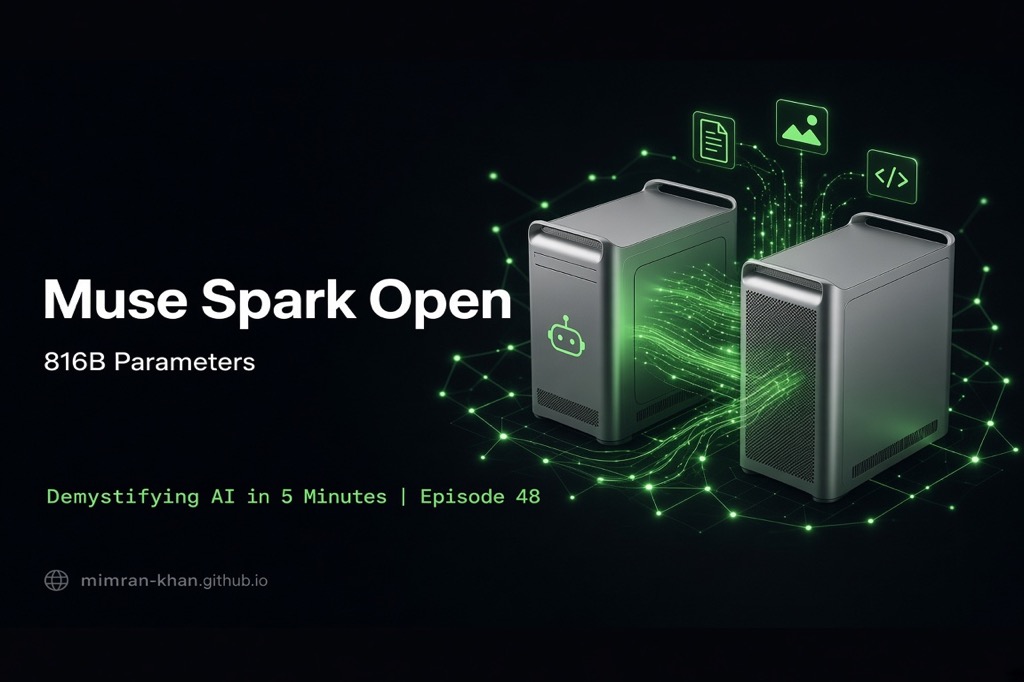
Meta AI Research released Muse Spark Open on October 15. It is an 816 billion parameter mixture-of-experts model with 42B active parameters, a 1 million token context window, and native multimodal capabilities. The headline number: it runs locally on two Apple M5 Ultra Mac Studios via MLX. Available on HuggingFace, SageMaker, Google Cloud, and Foundry. Works with SGLang, vLLM, TensorRT-LLM, llama.cpp, and Unsloth. Built for coding and agentic work.
# What You Actually Get
Muse Spark Open is Meta's biggest open-weight release to date. The mixture-of-experts architecture means only 42B parameters are active per token, keeping inference costs manageable despite the massive total parameter count. Here is the spec sheet.
The model uses a mixture-of-experts design with sparse routing. Each token activates roughly 42B parameters out of the full 816B. This means frontier-class knowledge with mid-size inference costs.
Entire codebases, full legal documents, multi-hour transcripts - all in a single context. No chunking hacks. No retrieval workarounds. Just drop the whole thing in.
Text, images, and audio are first-class input types. No adapter layers or bolt-on vision encoders. The model was trained end-to-end on multimodal data from the start.
Optimized for long-horizon tasks: multi-file code generation, multi-step tool use, extended reasoning chains. This is not a chatbot model. It is an agent backbone.
# How to Run It
The headline demo: two Apple M5 Ultra Mac Studios running Muse Spark Open locally via MLX. No cloud needed. No API keys. No GPU cluster. Just two desktops connected over Thunderbolt.
# Install MLX and download weights
pip install mlx-lm
huggingface-cli download meta-ai/muse-spark-open-816b-mlx

# Launch distributed inference across two M5 Ultras
mlx_lm.server \
  --model meta-ai/muse-spark-open-816b-mlx \
  --pipeline-parallel 2 \
  --max-tokens 1000000 \
  --port 8080

# The model shards across both machines automatically.
# Each M5 Ultra provides 512 GB unified memory.
# Total: 1 TB for the full 816B model in FP16.
# Why This Matters
Muse Spark Open is not just another model release. It marks a shift in what "local AI" means for professional developers and enterprises.
Until now, the top open-weight models were either smaller (Llama 3.1 405B) or restricted. Muse Spark Open is 816B with full open weights. No usage restrictions. No phone-home telemetry.
Running an 816B model on two consumer Mac Studios (not a datacenter, not an H100 cluster) breaks the "frontier models need cloud" assumption. Apple's unified memory architecture and MLX made this possible.
The 1M context window plus native tool-use training means Muse Spark Open can handle long-horizon agentic tasks: multi-file refactors, multi-step research workflows, extended code generation with self-correction.
Day-one support across SGLang, vLLM, TensorRT-LLM, llama.cpp, and Unsloth means every deployment scenario is covered: cloud serving, local inference, NVIDIA-optimized, and fine-tuning out of the box.
# Who Should Care
AI engineers building agents. The 1M context window and agentic training make this the best open-weight backbone for long-horizon tool-use agents. Pair it with your own tool APIs and skip the closed-model API costs.
Enterprises with data sovereignty needs. Run a frontier-class model entirely on-premises. No data leaves your network. Two Mac Studios cost less than one month of cloud GPU rental for comparable throughput.
Researchers who fine-tune. Unsloth support on day one means LoRA and QLoRA fine-tuning is immediately available. Train domain-specific experts on top of the 816B base without needing a full training cluster.
Code-heavy teams. Muse Spark Open excels at multi-file code generation, debugging across large repos, and sustained coding sessions that would exhaust smaller models' context windows.
816B parameters. Open weights. Runs on two Mac Studios. Muse Spark Open is the moment "local AI" stopped meaning "a small model that kind of works" and started meaning "a frontier model on your desk." The 42B active MoE keeps inference practical, the 1M context handles real workloads, and the framework ecosystem means you can deploy it however you want. The gap between closed and open-weight models just collapsed.
Enjoyed this?
New episodes Mon, Wed, Sat.