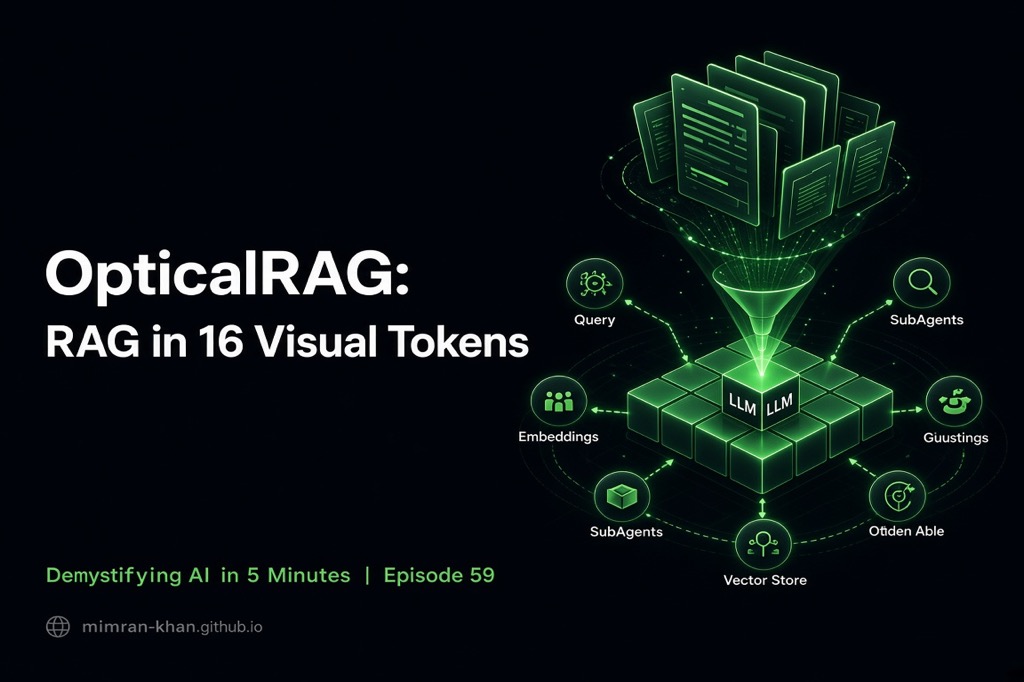
OpticalRAG (Liu et al., NeurIPS 2026 / arXiv:2611.13675) argues the RAG bottleneck is the compression modality, not raw information density. It renders docs as page images, encodes with a frozen ViT, retrieves via Encoder-Bridged Retrieval (no contrastive training), then Query-Driven Distillation packs the hit into 16 prefix tokens for frozen Qwen2.5-7B-Instruct. LongBench-v2: 35.79 vs closed-book 30.62 (+5.17). Best CAP on all three benches.
# The Bottleneck Is the Modality
Feeding long docs into the LLM is expensive. Aggressive text compression throws away layout, tables, and fine detail that a 1D token stream cannot keep. OpticalRAG says that is a modality choice, not a hard information limit.
Once structure is flattened to text, compressors cannot recover tables and figures cleanly.
Modern visual encoders pack a rendered page with little semantic loss - a tradeoff text alone cannot match.
# Classic RAG vs OpticalRAG
Same job: retrieve evidence, answer with an LLM. Different thing stuffed into the prompt.
# System Architecture
Five stages. Two frozen giants. One small trainable middle.
- →DeepEncoder / ViT
- →Qwen2.5-7B-Instruct
- →Encoder Bridge projection
- →Query-Driven Distillation
Plug-in stack: keep the backbone, train the bridge + compressor only. No expensive vision-language contrastive pretraining.
# Ingredient 1: Encoder-Bridged Retrieval
The hard part of pixel RAG: the user types text, the index holds visual features. OpticalRAG does not train a CLIP-style dual encoder from scratch.
Train contrastive text-image pairs so query and page live in one space. Expensive. Separate from the compressor.
Project query states into the already frozen visual feature space with a projection shared with the compressor. Retrieve without a second contrastive stage.
# Ingredient 2: Query-Driven Distillation
Retrieved pages still cost too many visual tokens. A lightweight cross-attention compressor condenses them into a query-conditioned prefix the LLM can actually afford.
Dense pack from retrieved page images (schematic width = budget before distill).
query-conditioned · injected as prefix
[v1 v2 ... v16]  <- 16 distilled visual prefixes
User: What does Table 3 report for X?
Assistant: ...
Not a generic summary of the page. The 16 tokens are shaped by the query, so different questions pull different evidence from the same pages.
# Why 16 Tokens Matter
Context windows grew. Cost and latency did not vanish. Compression is how RAG stays useful when every retrieved chunk eats budget.
Bar widths are relative for the article, not a paper-reported exact count for every baseline.
# How to Read CAP
Raw accuracy alone rewards fat prompts. CAP (compression-aware performance) rewards methods that beat closed-book while staying cheap.
The paper still reports raw S even when S < S₀. The compression bonus only kicks in when retrieval actually helps.
Paste a novel into context. Accuracy up a bit. Token bill huge. CAP stays modest.
+5.17 on LongBench-v2 with 16 tokens. That is the CAP story - lift per budget.
# What the Paper Measured
Authors: Senhao Liu, Yuheng Zhang, Chunyu Wei, Yueguo Chen, Xinran Zhang (Renmin University of China). Accepted at NeurIPS 2026. Same backbone for comparisons: Qwen2.5-7B-Instruct. Eval is multiple-choice long-context style.
Code: github.com/brighterr/OpticalRAG.
Bar widths relative to OpticalRAG 35.79. CAP on this bench: 49.68 (best).
Closed-book 30.62 (+5.17). Best raw + CAP at 16 tokens.
Win is CAP, not raw accuracy vs RECOMP / LLMLingua-v2.
Best raw + CAP; xRAG CAP 32.54 is a near-tie on 1 token.
OpticalRAG avg CAP 55.67 is best among compared methods. Neighbor bars are schematic relative height.
# When This Matters for You
Not a universal "replace every RAG stack" paper. It is a sharp bet on layout-heavy docs + tiny context budgets.
Layout-heavy PDFs, tiny token budgets, MC long-context evals, render pipeline available.
Clean text corpora, fat context OK, need exact quotes, text index already production.
CAP wins on all three benches. LongBench-v2 raw +5.17 at 16 tokens. Frozen backbone + shared bridge design.
BAMBOO raw is not the win. Eval is multiple-choice. Not "beats all RAG in production."
RAG does not have to mean dumping text into the prompt. OpticalRAG shows page images + Encoder-Bridged Retrieval + Query-Driven Distillation can land a LongBench-v2 +5.17 in 16 tokens, with the best CAP across three benches - without contrastive vision-language pretraining. Treat it as a compression architecture win for layout-heavy retrieval. Then check open-ended tasks and production latency before ripping out the text index.
Enjoyed this?
New episodes Mon, Wed, Sat.