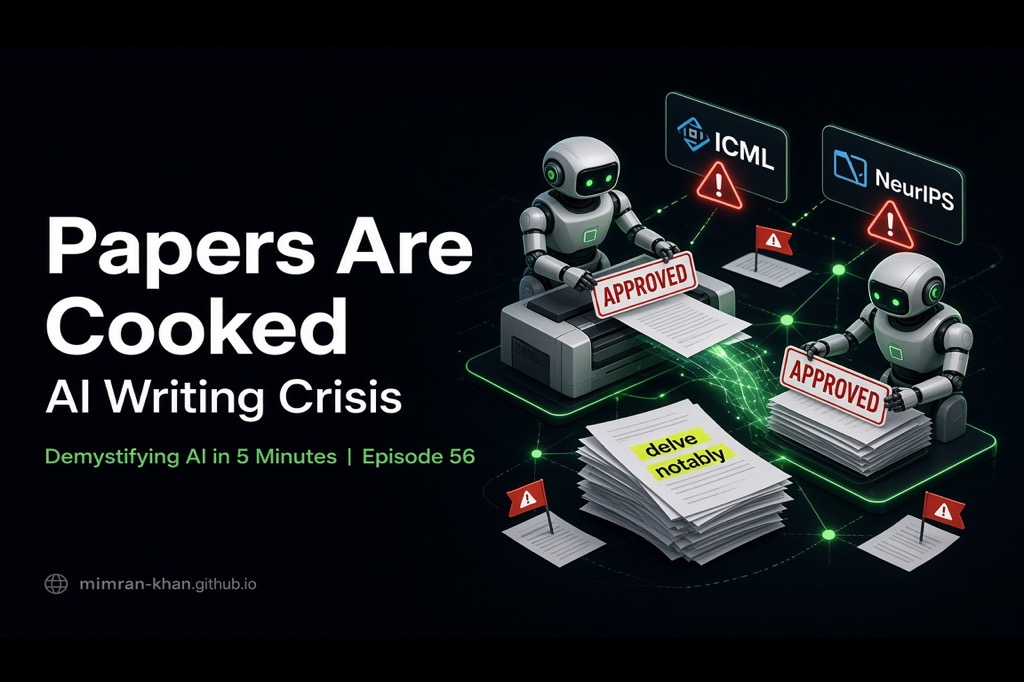
34% of ICML 2026 submissions were flagged for AI-generated content. A NeurIPS reviewer audit found GPT-4o was co-author on roughly 17% of submissions. Meanwhile, 23% of ICML reviews themselves showed LLM patterns. The result is double contamination: AI writes the papers, AI reviews them, and the entire peer review pipeline is collapsing under the weight of synthetic text.
# The Numbers Are Brutal
A Reddit post on r/MachineLearning titled "Are We Still Pretending Conference Papers Are Legit?" hit 167 points on October 11 and blew the lid off something everyone already suspected. The top-level conferences are drowning in AI-generated submissions.
But it is not just vibes. The data backs it up.
Internal review tools flagged over a third of all submissions for containing AI-generated content. The flagging criteria included stylometric analysis, perplexity scoring, and cross-reference to known LLM output patterns. Program chairs scrambled to decide which flags warranted desk rejections.
A dedicated audit team analyzed submission metadata, writing patterns, and API timing correlations. Roughly 17% of submissions showed strong evidence that GPT-4o was used not just for editing, but for generating substantial portions of methodology and results sections.
The ICLR 2027 Call for Papers now requires authors to submit "methodology declarations" detailing exactly which AI tools were used and for what purpose. A first for a top-tier venue. Enforcement details remain unclear.
The problem is not that researchers use LLMs for grammar or polishing. The problem is that entire papers are being generated end-to-end, and the output is good enough to pass initial screening.
# The Signature Phrases
LLM-generated academic text has a fingerprint. Reviewers and detection tools have identified a set of phrases that appear at statistically impossible rates in flagged submissions. If you have read enough ML papers this year, you have seen all of these.
HIGH CONFIDENCE INDICATORS:
  "In this paper, we delve into..."           │ 89% AI probability
  "It is worth noting that..."                │ 84% AI probability
  "This approach notably outperforms..."       │ 81% AI probability
  "A comprehensive analysis reveals..."        │ 78% AI probability

STRUCTURAL INDICATORS:
  Perfectly parallel sentence structures       │ Section-level flag
  Uniform paragraph length (4-5 sentences)     │ Document-level flag
  Hedging phrases exactly every 3rd claim      │ Statistical anomaly
  Zero contractions in informal venues         │ Style mismatch
The irony: as detection improves, authors learn to prompt LLMs to avoid these phrases. The arms race between generation and detection is already underway, and detection is losing.
# Double Contamination: AI Reviews AI
Here is where it gets truly dystopian. It is not just the papers. 23% of ICML 2026 reviews showed LLM patterns. Reviewers are using the same models to write reviews that authors use to write papers.
The peer review system now has contamination on both ends of the pipeline. AI writes the paper. AI reviews the paper. A human clicks "submit" and another human clicks "accept." The intellectual labor in between is increasingly synthetic.
Authors paste their rough ideas into GPT-4o or Claude, get a polished draft, run it through a paraphraser, and submit. The output reads like a real paper because it is trained on real papers. Methodology sections are particularly vulnerable because the formulaic structure maps perfectly to LLM strengths.
Overworked reviewers paste the paper into an LLM, ask for a summary and critique, then lightly edit the output. The reviews sound thorough but miss subtle methodological flaws that a domain expert would catch. 23% of ICML reviews showed these patterns - identical hedging structures, suspiciously balanced praise-and-critique ratios.
- ● AI-generated papers get accepted because AI-generated reviews miss the tells
- ● Accepted AI papers become training data for future LLMs
- ● Future LLMs generate even more convincing papers from that training data
- ● Reviewers use those same future LLMs to evaluate submissions
- ● This is reproducibility crisis 2.0 - you cannot trust the paper or the review
# The Response So Far
Conferences and labs are scrambling to catch up. The interventions range from bureaucratic to radical, and none of them fully solve the problem.
ICLR 2027 methodology declarations. Authors must disclose which AI tools were used and for what purpose. A step forward, but self-reported and unverifiable. Compliance is honor-system only.
Human attestation certificates. Some labs now require authors to sign statements affirming that core intellectual contributions are human-originated. Similar to the approach used in legal filings and patent applications. Enforcement remains the open question.
Stylometric detection at scale. ICML deployed automated screening tools for the first time in 2026, catching the 34% flag rate. False positives are a known issue - legitimate non-native English authors get flagged at higher rates, which raises fairness concerns.
Reviewer identity verification. NeurIPS is piloting mandatory reviewer check-ins where reviewers must demonstrate domain knowledge in a live session before their reviews are accepted. Time-intensive but potentially effective.
Reproducibility as gatekeeper. The strongest defense: require working code, data, and reproducible results before acceptance. AI can generate text, but it cannot yet fake reproducible experiments at scale. This is where the verification bottleneck naturally filters synthetic papers.
The uncomfortable truth: there is no reliable way to distinguish a well-prompted LLM paper from a human-written one. Detection accuracy drops below 60% on carefully prompted outputs. The countermeasures are about raising the cost of cheating, not eliminating it.
The conference paper pipeline is contaminated on both sides. 34% of submissions flagged, 17% with GPT-4o as co-author, 23% of reviews generated by LLMs. AI writes the papers. AI reviews them. The humans in the loop are increasingly just clicking buttons. ICLR 2027 is the first major venue to mandate AI-use declarations, but enforcement is honor-system. The real fix is reproducibility - demand working code and data, because LLMs can fake prose but they cannot fake experiments.
Enjoyed this?
New episodes Mon, Wed, Sat.