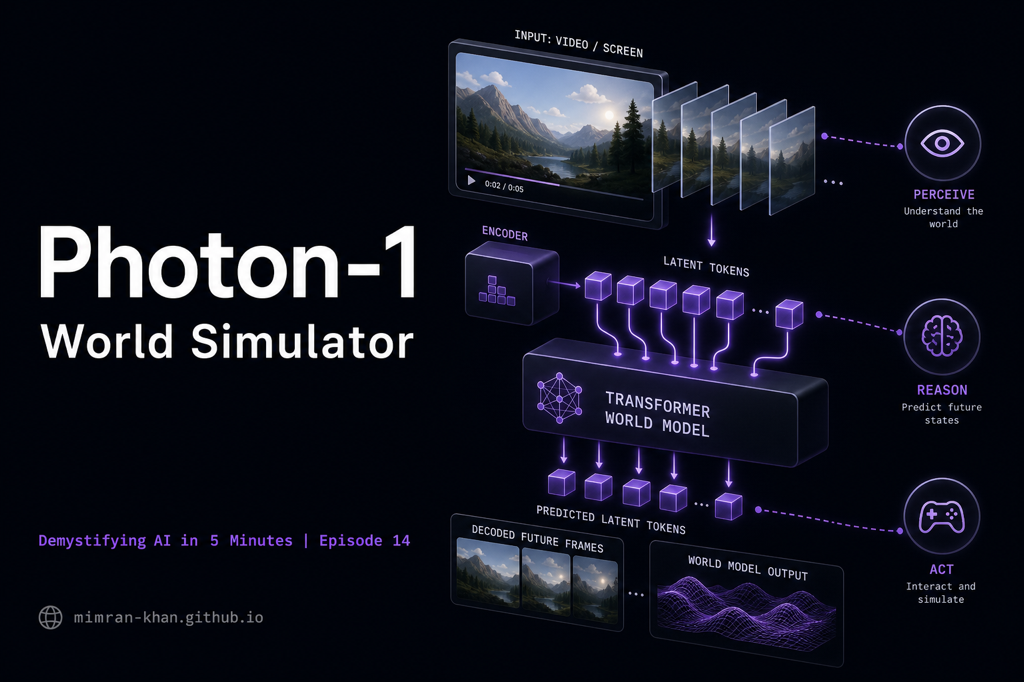
Induction Labs trained a 106B sparse MoE on 18 years of continuous screen recordings with zero action labels. Photon-1 does not generate video. It simulates environments: predicts physics, tracks objects through occlusion, and models cause-effect from raw pixel observations. No labels. No scene graphs. Just screens and a transformer. On internal benchmarks it beats Gemini 3.1 Flash-Lite at 30x less pretraining compute, then transfers to checkers and billiard physics despite never seeing either domain.
# What Is a World Model
Video generation and world simulation look identical on the surface. Both produce video frames. But they solve fundamentally different problems.
A video generator asks: "what looks realistic?" A world model asks: "what happens next given this action?" One makes movies. The other makes decisions.
Why this distinction matters: video generation models create content. World models create understanding. An agent that needs to decide "should I click this button?" requires a world model, not a video generator. Photon-1 is built for the second problem.
# The Training Data
Most agent training pipelines require someone to label every action in every video frame. Click here. Type that. Scroll down. That labeling is called an inverse dynamics model, and it is the bottleneck that kills scale.
Induction Labs dropped the labels entirely. The model learns higher-level behavior from raw observation rather than cataloging individual mouse clicks.
Continuous screen recordings
Sampled at 1 fps
After FSQ compression
During pretraining
2 billion publicly available videos
(internal index)
~2 million computer screen recordings
Desktop, mobile, application demos
575 million frames at 1 fps
552 billion tokens
= 18 years of continuous recording
The conventional approach treats action labels as essential. You watch a human use a computer, you label every click and keystroke, then you train the model on those labels. Induction Labs argues this is backwards.
Instead of teaching the model what happened, teach it what comes next. A model that can predict future screen states has implicitly learned the actions that cause those states. The labels are unnecessary overhead that limits how much data you can use.
# The Architecture
Photon-1 is a latent world model. Screens get compressed to compact latent tokens, a sparse transformer predicts the next latent state, and a decoder reconstructs frames. Everything happens in representation space. No raw pixels are generated during training.
Each video frame is compressed into 960 discrete tokens. Each token is an 8-dimensional vector where each dimension takes 1 of 5 values, giving a codebook of 58 possible codes per token.
106B total parameters, 5B active per token. Trained at 32K context length with custom fused PyTorch kernels for the vision encoder and MoE layers. Sustains 40% end-to-end MFU.
The model predicts the next discrete latent token representing the future video state. Not next-pixel. Not next-text-token. A decoder reconstructs frames from latent predictions only at inference time.
The FSQ encoder uses a differential latent approach: it encodes frame pairs, so the latents describe changes between frames rather than raw frame contents. This is what enables the 100x compression gain. Most of a screen recording is static. The differential encoder captures only what changed.
# The Benchmarks
After pretraining, Induction Labs finetuned Photon-1 on fewer than 35,000 computer use trajectories and applied online RL on Linux VMs. The results on their internal benchmark: beats Gemini 3.1 Flash-Lite at 30x less pretraining compute. But the transfer experiments are where it gets genuinely interesting.
$0.11 per 1M tokens
$0.36 per 1M tokens
30x less pretraining compute. 3x cheaper to serve. But this is an internal benchmark that has not been independently verified.
20,000 tournament games from the Open Checkers Archive 2.0. Never seen during pretraining. Finetuned and compared against vision encoder and LLM baselines.
Result: beats both baselines on world simulation and move quality. A model trained on desktop recordings learned enough about state transitions to play a board game.
10,000 synthetic games simulated at 5 fps. Mean absolute error of ball positions against a ground-truth physics engine.
Photon-1 saw only desktop video during pretraining. Zero game footage. Zero physics simulations. Yet a model that watched people use VS Code learned enough about how the world works to simulate billiard collisions better than an LLM trained on 20 trillion text tokens. Pretraining on screen recordings transfers to completely unrelated physical dynamics.
# The Numbers
Total pretraining compute: 4.4 x 10²² FLOPs. Single epoch over the full dataset.
Each screen compressed to ~2.2 KB. 100x smaller than OCR or multimodal representations.
Than Gemini 3.1 Flash-Lite on the same computer use benchmark. 3x cheaper to serve.
# What's Missing
Time for the cold water.
The headline "zero labels" is technically correct but incomplete. The pretraining used zero labels. But the finished computer agent still required fewer than 35,000 labeled trajectories for finetuning, plus reinforcement learning on Linux VMs.
The video pretraining taught the model how environments behave. The finetuning and RL taught it how to take actions. "Zero labels" describes pretraining, not the full pipeline.
# Why This Matters
World models are the foundation for autonomous agents that need to understand the consequences of actions before taking them. If next-state prediction alone teaches agents to act, it removes the most expensive constraint in agent training: human annotation.
Instead of hiring annotators to label mouse clicks, you just need more video. That is an easier scaling problem. 18 years of desktop video is a fraction of what is publicly available online.
A model trained on desktop recordings learned billiard physics. This suggests screen recordings teach general spatial reasoning, not just UI navigation.
30x less pretraining compute, 3x cheaper serving. If imagination models match larger traditional models, the cost of building computer agents drops by an order of magnitude.
An agent that can simulate "if I click this button, what happens?" does not need to actually click it to evaluate the outcome. World models enable lookahead planning for autonomous agents.
The paradigm shift: video generation models like Sora create content. World models like Photon-1 create understanding. The first is entertainment. The second is infrastructure for autonomous agents that need to reason about consequences before they act.
Video generation models make movies. World models make decisions. Photon-1 is the first commercial proof that you can build a world simulator from unlabeled screen recordings. The bet is that action labels are unnecessary overhead, and next-state prediction alone teaches an agent how to act.
Induction Labs has not proven it conclusively. Internal benchmarks from a 2-person YC startup are not proof. But 0.47 MAE on billiard physics from a model that only watched desktop recordings? That is a data point worth watching.
Enjoyed this?
New episodes Mon, Wed, Sat.