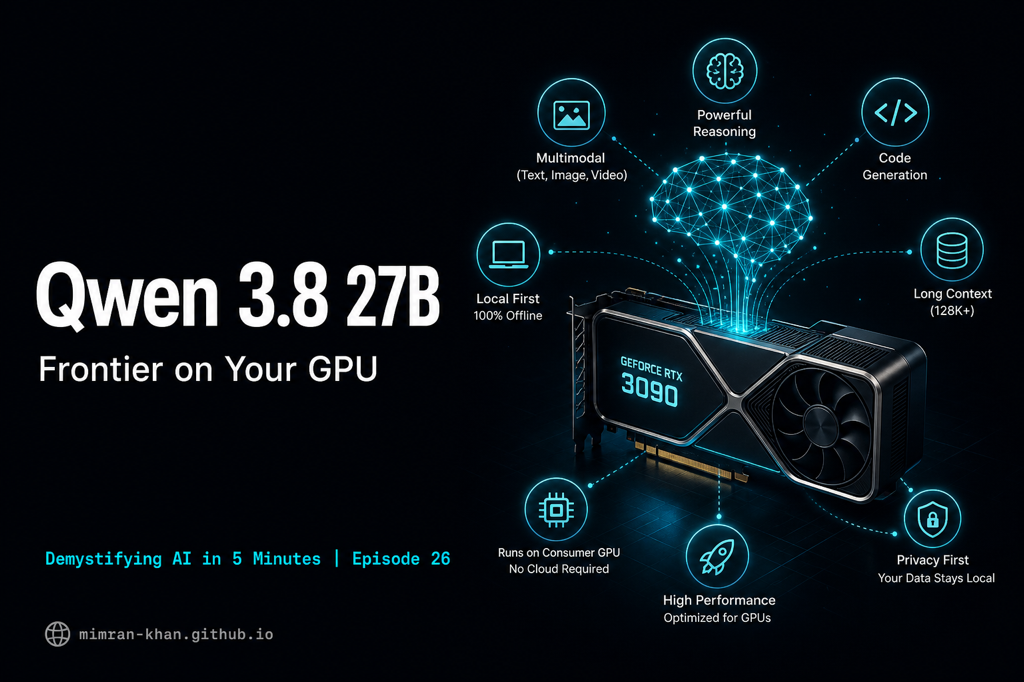
Qwen 3.8 27B is a 27B dense multimodal model from Alibaba that runs on ~17GB VRAM at 4-bit quantization. Native 262K context, extendable to 1M. Text, image, and video understanding built in. Multi-token prediction head for speculative decoding. Outperforms Qwen3.7-Plus and claims parity with Claude Opus 4.6 Max on some coding tasks. Apache 2.0. Available on Ollama, LM Studio, and vLLM from day zero. 1M downloads in 24 hours.
# The Numbers Nobody Expected
This is not another MoE with inflated total parameters. 27B dense means every parameter activates on every token. No routing, no sparsity tricks, no asterisks. And the adoption numbers are unprecedented for a model this size.
10,000+ downloads in 38 minutes. GGUF hit #3 trending on Hugging Face. Available on Ollama, LM Studio, vLLM, and SGLang from day zero. The community did not wait for benchmarks - they ran it and confirmed the claims themselves.
# The $300 GPU That Runs It
Here is the real story. A used RTX 3090 costs $300. It has 24GB VRAM. Qwen 3.8 27B at Q4 quantization needs ~17GB. That leaves headroom for context. This is a frontier-scoring model running on hardware available in every used GPU market on the planet.
| Precision | VRAM | Min Hardware | Approx. Cost |
|---|---|---|---|
| Q4 (INT4) | ~17GB | RTX 3090 24GB | ~$300 used |
| FP8 | ~28GB | RTX 4090 / A6000 | ~$1,200+ |
| BF16 (Full) | ~56GB | A100 80GB / 2x RTX 3090 | ~$8,000+ |
REAL-WORLD THROUGHPUT:
Single stream, Q4 quantization. ~$300 on the used market. The sweet spot for solo developers.
NVFP4 + MTP speculative decoding. Pushing 200+ tok/s in optimized configurations.
Full BF16 fits in unified memory. Silent, always-on local inference. No GPU required.
At 1M context window. The workstation setup for teams that need the full context range.
At 114 tok/s on a $300 GPU, a 500-token response takes 4.4 seconds. That is faster than most API round-trips when you include network latency. And the cost after buying the GPU is zero per token, forever.
# What Makes It Different
Plenty of open models exist at 27B. What separates Qwen 3.8 27B is the combination of features you normally only get from API providers, packaged into something that runs locally.
The model ships with an MTP head that predicts multiple tokens simultaneously. Combined with speculative decoding, this pushes throughput significantly higher than standard autoregressive generation. On RTX 5090, this is the difference between 148 and 200+ tok/s.
Not every query needs deep reasoning. The reasoning_effort parameter lets you dial reasoning depth up or down per request. Quick factual lookups run fast and cheap. Complex coding problems get full chain-of-thought. The same model serves both use cases.
262,144 tokens natively - enough for most entire codebases in a single prompt. YaRN extension pushes to 1M tokens for extreme use cases. At Q4, the 262K context fits comfortably in 24GB VRAM with room to spare.
# Ollama (easiest)
ollama run qwen3.8:27b

# LM Studio
# Search "Qwen3.8-27B-GGUF" in the model browser

# vLLM (production serving)
vllm serve Qwen/Qwen3.8-27B --quantization awq

# SGLang
python -m sglang.launch_server --model Qwen/Qwen3.8-27B
# The Benchmark Reality
Qwen claims parity with Claude Opus 4.6 Max on some coding and computer-use tasks. Those claims are unverified independently. What is verified: Artificial Analysis gave it a score of 52 on the Agentic Index, ahead of much larger frontier models.
Ignore the frontier-parity marketing. What matters is this: a model scoring 52 on the Agentic Index and beating Qwen3.7-Plus overall - a model that previously required API access - now runs on your desk for the cost of one month of API bills. Even if the Opus 4.6 Max claims are overstated by 20%, the value proposition is extraordinary.
# The "You Don't Need an API" Moment
Every year, the claim resurfaces: "open models are catching up." This time it is different. Not because the benchmarks are better, but because the hardware barrier collapsed.
A $300 used RTX 3090 runs Qwen 3.8 27B at 114 tok/s. No API key, no rate limits, no per-token billing. Code completion, agentic workflows, multimodal analysis - all offline.
Run it on vLLM or SGLang behind your own API. Your data never leaves your infrastructure. No vendor lock-in, no surprise billing, no compliance headaches. Apache 2.0 means do whatever you want with it.
DGX Spark pushes ~210 tok/s at 1M context. Air-gapped deployment is trivial. No external API dependencies for production inference. Scale horizontally with commodity hardware.
The API era is not over. But the API-only era is. Qwen 3.8 27B proves that a model scoring near-frontier on agentic tasks can be downloaded and running on a $300 used GPU in under 5 minutes. Zero per-token cost. Zero network latency. Zero vendor dependency. Apache 2.0. This is the model that makes local-first AI engineering viable - not as a compromise, but as a genuine alternative.
Enjoyed this?
New episodes Mon, Wed, Sat.