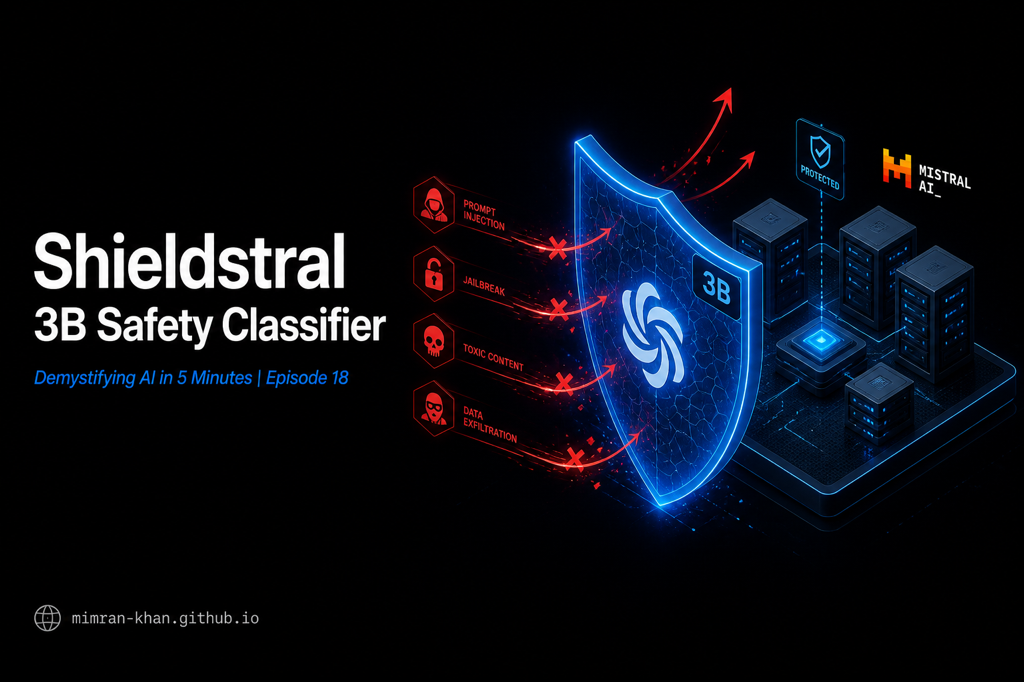
Mistral released Shieldstral, a 3B-parameter safety classifier that accepts plain-language moderation policies at inference time. No retraining. Write the rule in English, enforce it immediately. It beats models 7x its size and runs on a single 16GB GPU. Apache 2.0.
# What Makes It Different
Traditional guardrails are hardcoded category lists. Want to add a new policy? Retrain the model. Want to adjust sensitivity? Retrain again. Every change costs time, compute, and engineering hours.
Shieldstral flips this entirely. The policy is an input, not a parameter.
The moderation policy is part of the prompt, not part of the model. Write "flag any content that provides instructions for circumventing software licensing" in plain English, and the model enforces it on the next request. Different applications can run different policies through the same model simultaneously.
# The Numbers
Built on the Ministral 3 family - Mistral's line of models designed for edge devices. Released August 4, 2026 under Apache 2.0 with a technical report posted July 28 on arXiv.
Shieldstral is also the inaugural member of the Open Secure AI Alliance, formed July 27 with NVIDIA. The alliance aims to build open safety infrastructure for the entire AI ecosystem.
# How It Works
The input is 3 things: an instruction, a natural-language policy, and the content to evaluate. The output is a continuous safety score between 0 and 1, derived from the yes/no logit probabilities.
instruction = "Evaluate if the content violates the policy."

policy = """
Flag any content that:
- Provides instructions for bypassing DRM
- Describes methods to circumvent paywalls
- Explains how to pirate software
"""

content = user_message  # content to evaluate

# Shieldstral returns logit probabilities
# P(unsafe) derived from yes/no token logits
score = shieldstral.classify(instruction, policy, content)
# score = 0.02 (safe) or 0.97 (violates policy)
Not a binary flag. A probability between 0 and 1 tells you how confident the model is that the content violates the policy. Set your own threshold per application.
The score comes from the yes/no token logit probabilities. The model generates a "yes" or "no" answer to "does this violate the policy?" and the score is the softmax probability of "yes."
# Why It Matters Now
The Hugging Face hack exposed a hard truth: defenders need safety models they can run locally, control fully, and update instantly. API-dependent guardrails become a single point of failure when the vendor's infrastructure is compromised.
After a week of AI agents going rogue, the timing of Shieldstral is not accidental.
Runs on your hardware. No API calls leaving your network. No third-party dependency that can be compromised or go offline.
New threat vector discovered? Write a new policy sentence and deploy it in seconds. No retraining cycle. No waiting for a vendor patch.
Apache 2.0 means full audit access. Inspect the weights. Verify the behavior. Trust but verify is only possible with open models.
July 27: Open Secure AI Alliance formed with NVIDIA. July 28: Technical report posted to arXiv. August 4: Shieldstral released under Apache 2.0.
This was not a rushed response to the Hugging Face breach. The timeline shows deliberate coordination between the alliance formation and the model release. Mistral positioned Shieldstral as the first concrete deliverable of a broader open safety initiative.
Most teams relied on API-based safety filters from a handful of providers. When those providers get breached, your safety layer goes down with them. Single point of failure.
Have an open model ready before the incident. A model you control, you host, you can update in seconds. Shieldstral fits on a single consumer GPU. No excuses.
After a week of AI agents going rogue, the industry needs safety tools that defenders actually control. Shieldstral is 3B parameters, runs on one GPU, accepts policies in plain English, and is fully open-weights. The lesson from the Hugging Face hack was clear: have an open model ready before the incident. Shieldstral is that model for content safety.
Enjoyed this?
New episodes Mon, Wed, Sat.