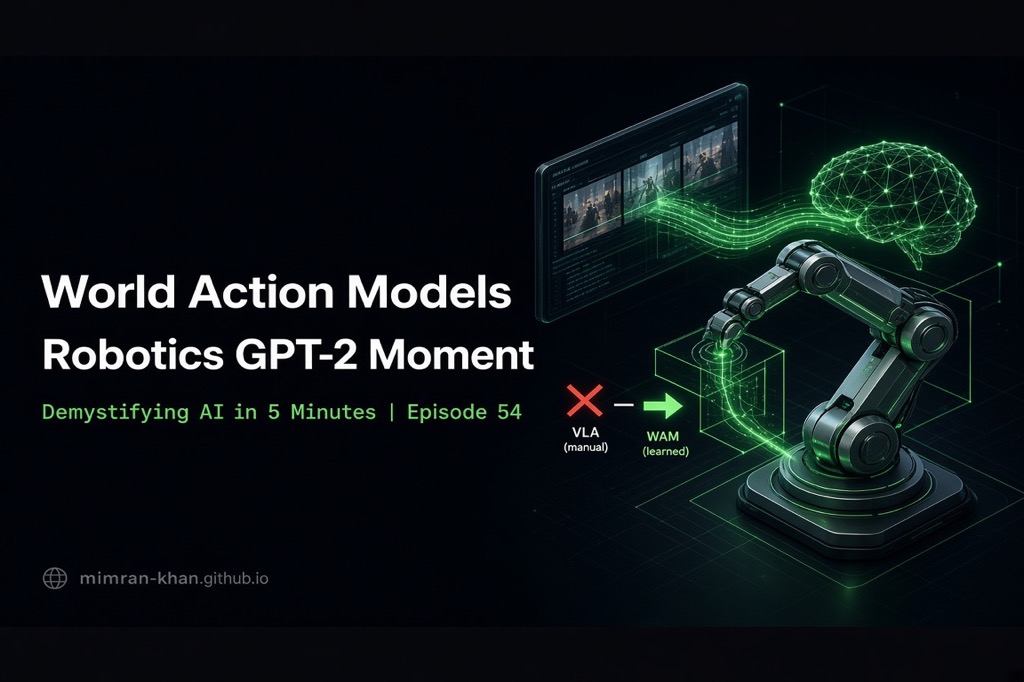
World Action Models (WAMs) learn physics and manipulation from massive video datasets, similar to how LLMs learn language from text. They are outperforming hand-coded Vision-Language-Action models (VLAs) on manipulation tasks and generalizing to unseen objects and environments. The r/ML community is calling it robotics' GPT-2 moment. The pre-training paradigm has officially hit robotics.
# The Key Insight: VLAs Are Prompt Engineering
A post on Reddit r/ML titled "World Action Models vs VLAs: Robotics Just Had Its GPT-2 Moment" hit 119 points on October 11. The core argument is clean and devastating.
Vision-Language-Action (VLAs)
- ✖ Hand-designed perception pipelines
- ✖ Manually specified action spaces
- ✖ Task-specific training data
- ✖ Poor generalization to new objects
Manually crafting rules to coax behavior from a system that does not truly understand physics.
World Action Models (WAMs)
- ✔ Learned physics from video data
- ✔ Emergent action understanding
- ✔ Pre-trained on internet-scale video
- ✔ Generalizes to unseen environments
Train on everything, fine-tune for specific tasks. The model learns physics the way GPT learns grammar.
The comparison is powerful because it maps perfectly. VLAs are to WAMs what rule-based NLP was to transformers. You can manually engineer rules, or you can let the model learn the rules from data. The data approach always wins at scale.
# How World Action Models Actually Work
The core pipeline has three stages. Each one mirrors a concept from language model training.
The model watches millions of hours of video showing objects being manipulated, falling, sliding, stacking, and breaking. It learns physics the way GPT-2 learned grammar: by predicting what happens next. No labels, no annotations. Just raw video data at internet scale.
The pre-trained model is fine-tuned on robot demonstration data. This is a small, curated dataset of actual robot trajectories. Because the model already understands physics, it needs far less demonstration data than VLAs. Think instruction tuning: the model already knows the language, it just needs to learn the task format.
The trained WAM can manipulate objects it has never seen, in environments it has never been in. A robot trained to stack blocks can also stack cups, books, and phones. Generalization is not engineered. It emerges from scale.
# Why "GPT-2 Moment" Is the Right Frame
GPT-2 was not the best NLP model when it launched. It was the moment people realized that pre-training on raw data at scale was the winning strategy. WAMs are at that same inflection point.
More video data = better physics understanding. This is the same scaling law that took us from GPT-2 to GPT-4. WAMs are on the early part of the curve. Throwing more compute and data at this problem will predictably produce better robots.
Apple launched a dynamic virtual GPU cloud for distributed training. Google's Antigravity project is using agents for scientific discovery, including robotics. The compute infrastructure needed for WAM training at scale is being built right now by the biggest companies on Earth.
YouTube alone has billions of hours of manipulation videos: cooking, assembly, repair, sports, crafts. The training data for WAMs already exists at a scale that no robotics lab could ever collect manually. This is the same data advantage that gave LLMs their power.
# What This Changes
If WAMs follow the LLM trajectory, here is what the next 2-3 years look like for robotics.
VLAs need thousands of demonstrations per task. WAMs need a handful. This is the difference between a $10M training dataset and a weekend of teleoperation. Robotics becomes accessible to startups.
A WAM trained on videos of human hands can transfer to a robot gripper because it learned the physics, not the specific hardware. Different robot forms become interchangeable at the policy level.
VLAs relied heavily on simulated environments. WAMs learn from real-world video. You do not need to simulate physics when you can learn it from reality. This bypasses the sim-to-real gap entirely.
One expensive WAM pre-training run, fine-tuned cheaply for each application. The economics mirror LLMs: train once, deploy everywhere. This is how robotics scales from labs to factories.
World Action Models are to robotics what GPT-2 was to NLP: the proof that pre-training on raw data beats hand-engineering. VLAs had their run. But when you can learn physics from YouTube instead of coding it by hand, the outcome is inevitable. Robots will generalize the way language models generalize. The pre-training era of robotics is here, and it is following the exact same playbook.
Enjoyed this?
New episodes Mon, Wed, Sat.