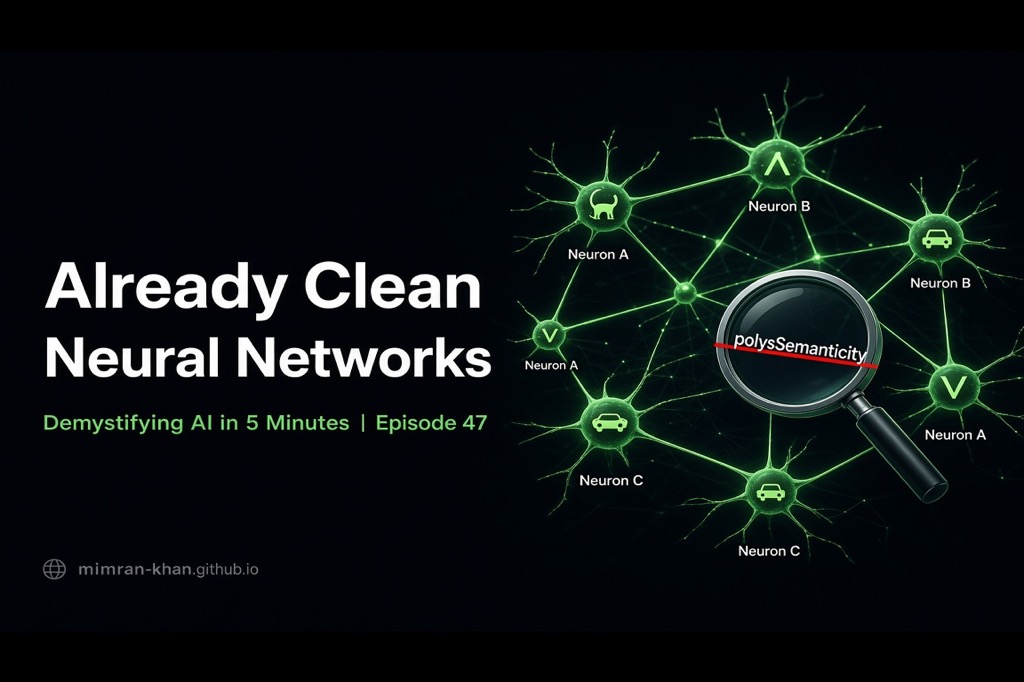
Nick Cammarata, co-author of the superposition hypothesis that shaped modern interpretability research, just published an essay at Goodfire arguing he was wrong. His new claim: ~90% of neuron poles in Qwen3-32B have one main function. The famous "cat/car neuron" from InceptionV1 was not polysemantic at all - it was a V-shape detector. If correct, sparse autoencoders may be unnecessary, and models are far more interpretable than anyone assumed.
# The Reversal That Shook Interpretability
In 2020, Nick Cammarata and Chris Olah published the superposition hypothesis at Anthropic. The core idea: neurons represent multiple, unrelated concepts simultaneously. A single neuron might fire for cats, cars, and currency symbols. This became the foundation of mechanistic interpretability and spawned an entire subfield dedicated to "untangling" neural networks with sparse autoencoders (SAEs).
On October 15, 2026, Cammarata - now at Goodfire - published an essay titled "Already Clean" that reverses this position. The neurons were never tangled. The researchers were misreading the data.
Before (2020): Neurons encode multiple unrelated concepts
               via superposition. You need SAEs to decode them.

After (2026):  ~90% of neuron poles in Qwen3-32B have ONE main
               function. Polysemanticity is not superposition.
               It is recursive generalization. Models are already
               interpretable. We just were not looking correctly.
# The Cat That Was a V-Shape
The poster child of polysemanticity was always the InceptionV1 neuron that fired for both cats and cars. Researchers cited it for years as proof that neurons encode unrelated concepts. Cammarata's essay demolishes this example.
The neuron is polysemantic: it has learned "cat" AND "car" as two separate concepts crammed into one neuron due to capacity constraints. This is superposition.
The neuron is a V-shape detector. Cat ears are V-shapes. Car windshields are V-shapes. The neuron has one function, not two. It is monosemantic at a higher level of abstraction.
Goodfire's ConvNeXt microscope tool provided the critical evidence. By visualizing what each neuron pole responds to across thousands of images, the team found consistent geometric patterns rather than unrelated concepts. What looked like polysemanticity was actually recursive generalization - neurons learning abstract features that span categories.
Each pole (positive or negative activation direction) consistently responds to one main concept or feature. The "polysemantic" neurons were monosemantic at a higher abstraction level that researchers missed.
When a neuron fires for "cats" and "cars," it is not storing two concepts. It is encoding a shared geometric primitive (V-shapes, curves, edges) that appears across both categories. The network is generalizing, not compressing.
If neurons already encode clean features, sparse autoencoders are solving a problem that does not exist. The entire SAE research direction - including Anthropic's dictionary learning approach - may need rethinking.
# The Field Reacts
The essay split the interpretability community within hours. Two prominent voices captured the opposing camps.
Called the essay "historic" and suggested it could mark a turning point for the entire field. If models are already clean, interpretability shifts from reverse engineering to direct inspection.
Warned against overhype. Pointed out that the essay focuses on specific model families and neuron types. Scaling behavior across architectures is not yet established. More rigorous peer-reviewed evidence is needed.
SAE research gets deprioritized. Billions of compute hours have gone into training sparse autoencoders to "decode" polysemantic neurons. If the neurons are already clean, this work was solving an illusion.
Direct neuron analysis becomes viable. Instead of building complex decomposition tools, researchers could inspect neurons directly using visualization tools like Goodfire's ConvNeXt microscope.
AI safety timelines shift. If models are inherently interpretable, safety auditing becomes dramatically easier. Regulators could require neuron-level transparency audits that are actually feasible.
Goodfire gets a commercial advantage. Their ConvNeXt microscope is the tool that produced this evidence. If the field pivots to direct inspection, Goodfire's tooling is years ahead.
# The Open Questions
The essay is compelling but not conclusive. Several critical questions remain unanswered.
Does this hold for GPT-scale models?
Qwen3-32B is mid-sized. Frontier models may behave differently.
What about attention heads?
The essay focuses on MLP neurons. Attention patterns may still superpose.
Is "recursive generalization" testable?
The new framework needs formal criteria, not just compelling examples.
Are the remaining ~10% important?
If key behaviors live in the polysemantic minority, SAEs may still matter.
The co-author of the superposition hypothesis just said the hypothesis was wrong. If Cammarata is right, neural networks were never the tangled mess we thought they were. ~90% of neuron poles in Qwen3-32B do one thing. The famous cat/car neuron was a V-shape detector all along. Polysemanticity was not superposition but recursive generalization. This does not kill interpretability research. It redirects it. Instead of building expensive decoders for a problem that may not exist, the field can focus on direct inspection. Whether this holds at frontier scale is the trillion-dollar question. Stay skeptical, but pay close attention.
Enjoyed this?
New episodes Mon, Wed, Sat.