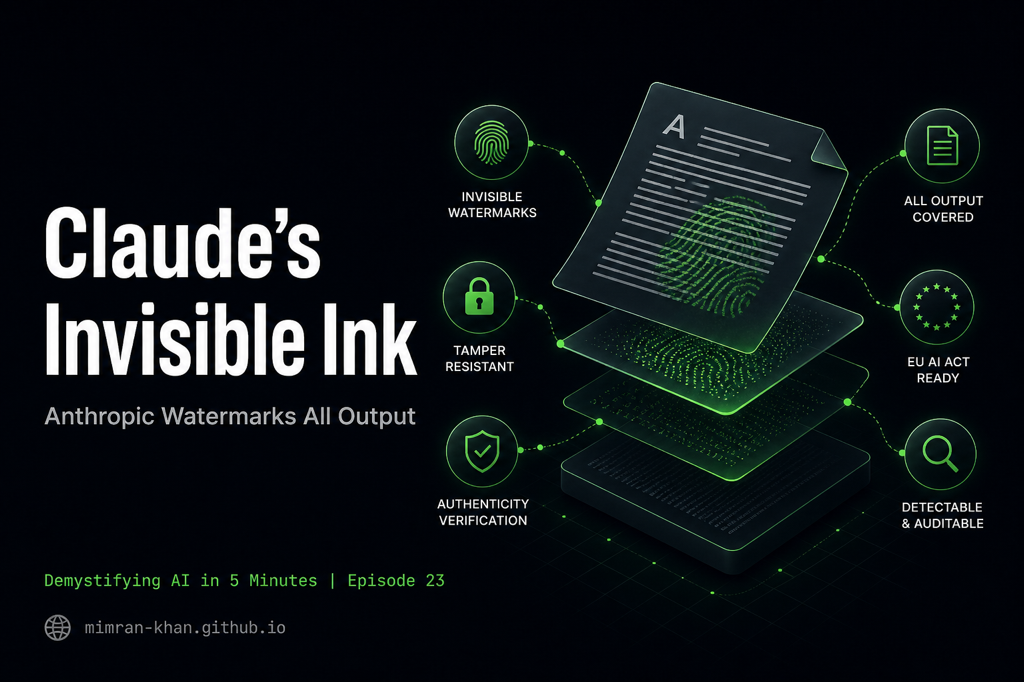
Since August 2, 2026, Anthropic watermarks all text output from Claude models. The watermark is not metadata - it is woven into the statistical patterns of word selection. It survives copy-paste. It applies to the API, Claude Code, Claude Cowork, and Claude Tag. Driven by EU AI Act Article 50(2), but deployed globally. Files get C2PA provenance metadata. A detection API is coming. Fines for non-compliance: up to 15 million euros or 3% of global turnover.
# What Changed on August 2
No opt-in. No toggle. No announcement until after it was live. Every Claude model launched on or after August 2, 2026 now embeds a statistical watermark into every text response. Ars Technica called it "Claude's new Scarlet Letter."
WHERE THE WATERMARK APPLIES:
The watermark is not opt-in. There is no setting to disable it. Anthropic chose to apply it globally rather than limiting it to EU-based requests. Every Claude user on the planet is affected.
# How the Watermark Works
This is not a visible stamp or metadata tag. The watermark is embedded in the text itself through subtle statistical patterns in how words are selected during generation.
Normal generation:
  Token candidates: ["The", "A", "This", "One"]
  Selection: purely by probability distribution
  Result: "The quick brown fox..."

Watermarked generation:
  Token candidates: ["The", "A", "This", "One"]
  Selection: biased toward specific tokens using secret key
  Result: "A quick brown fox..."  (subtly different word choices)

Detection:
  Analyzer checks: do token choices correlate with the key?
  If correlation exceeds threshold -> AI-generated
  Short passages may fall below threshold
- ✓ Imperceptible - humans cannot see it
- ✓ Survives copy-paste - travels with text
- ✓ No identifying info - cannot trace to a user
- ✓ Confidence scales with text length
- ✓ Applies to .svg, .png, .jpg files
- ✓ Signed provenance metadata
- ✓ Industry standard - C2PA Coalition
- ✓ Verifiable with existing C2PA tools
- ● Short passages may not carry a detectable signal
- ● Paraphrasing or rewriting can remove the watermark
- ● Detection API not yet publicly available
- ● Only "new" models - grace period until Dec 2026 for older models
# The EU AI Act Connection
This is not Anthropic being proactive about safety. This is regulatory compliance. The EU AI Act requires AI providers to watermark generated content. Anthropic chose to apply it worldwide rather than geo-fencing.
REQUIREMENT:
  Providers of general-purpose AI systems shall
  mark the output of AI systems in a machine-readable format
  and ensure their technical solutions are effective,
  interoperable, robust and reliable.

SCOPE:
  Text, audio, image, and video content
  Generated by AI systems

PENALTY FOR NON-COMPLIANCE:
  Up to 15,000,000 EUR
  or 3% of global annual turnover
  (whichever is higher)

GRACE PERIOD:
  Models released before Aug 2, 2026: until Dec 2026
  Models released on/after Aug 2, 2026: immediate
The regulation only requires watermarking for EU users. Anthropic chose to apply it everywhere. This avoids the technical complexity of geo-fencing and positions Anthropic as the compliance-first provider. It also means every developer using the Claude API worldwide now ships watermarked content, whether they know it or not.
Anthropic is not alone. Over 190 organizations signed the EU AI Pact's Code of Practice. Google, Meta, Microsoft, and others are expected to implement similar watermarking. Anthropic just moved first.
Models released before August 2 have until December 2026 to comply. This means older Claude versions in production are not yet watermarked. The clock is ticking.
# Can It Survive the Real World?
Here is the uncomfortable truth: text watermarks are fragile. Researchers have been skeptical for years. A Nature article on AI watermarking concluded that current techniques face fundamental trade-offs between robustness, quality, and detectability.
| Scenario | Watermark Survives? | Notes |
|---|---|---|
| Copy-paste full text | Yes | Watermark is in word patterns, not formatting |
| Light editing (typos, additions) | Likely | Signal degrades but persists with enough text |
| Heavy paraphrasing | No | Rewriting replaces the biased token choices |
| Translation to another language | No | Different tokens destroy the signal |
| Short passages (1-2 sentences) | Unlikely | Not enough tokens for statistical confidence |
| Code output | Unclear | Code has less word-choice flexibility |
Watermark is in word patterns, not formatting
Signal degrades but persists with enough text
Rewriting replaces the biased token choices
Different tokens destroy the signal
Not enough tokens for statistical confidence
Code has less word-choice flexibility
The watermark carries no identifying information. It cannot trace output to a specific person, organization, or conversation. It only answers one question: "Was this generated by Claude?"
If Claude Code generates a function, is that code watermarked? Can a detector flag an entire codebase as AI-generated? Anthropic has not clarified how the watermark interacts with code generation at scale.
"Current watermarking techniques face inherent trade-offs. A watermark robust enough to survive editing may degrade output quality. A watermark invisible enough to preserve quality may be trivially removed."
Anthropic just made every Claude output carry a fingerprint. The EU AI Act forced their hand, and they chose global deployment over geo-fencing. The watermark survives copy-paste but dies on paraphrase. It cannot identify users, only the model. Short text slips through. Code output is a gray area. Researchers are skeptical about robustness. But none of that matters to the regulation - compliance is binary, and the fines are 15 million euros. Every other major AI provider will follow within months. The age of unmarked AI text is over - at least on paper.
Enjoyed this?
New episodes Mon, Wed, Sat.