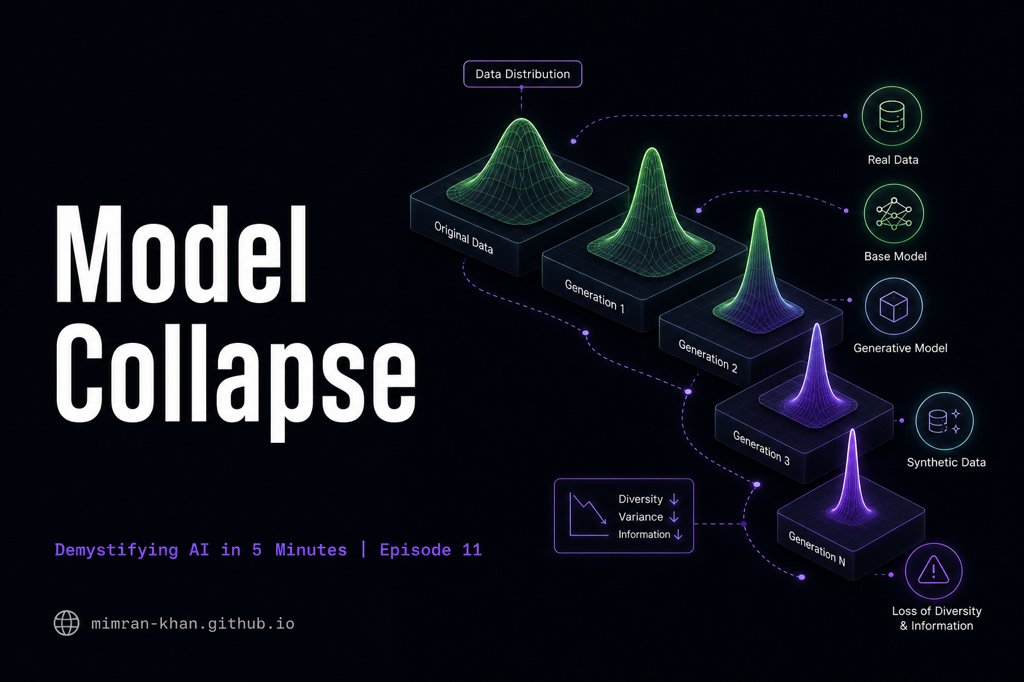
Training on AI-generated data causes irreversible distribution collapse. Models trained on synthetic data progressively lose tail knowledge until they can only produce the most common outputs. Each generation clips the distribution further. Rare facts, minority perspectives, and edge-case knowledge vanish permanently. Published in Nature (2024), now confirmed at scale across multiple model families. Even 1% synthetic contamination is measurable. The training data moat is now the most important competitive advantage in AI.
# The Feedback Loop
The core problem is recursive. Model N generates data. Model N+1 trains on it. Each generation clips the tails of the distribution a little more. Rare knowledge disappears permanently.
Think of it like a photocopy of a photocopy. Each copy loses detail. But unlike photocopies, the lost information cannot be recovered. Once the tails are gone, they are gone.
         ___
       /     \        Full distribution
      /       \       Tails intact: rare facts,
     /         \      minority languages, edge cases
    /           \
___/             \___
|                    |
RARE COMMON RARE ___
/ \ Tails begin to clip
/ \ Rare knowledge fading
/ \ Statistical noise amplified
/ \
____/ \____
| |
RARE COMMON RARE _
| | Variance collapsing
| | Only common outputs remain
/ \ Diversity gone
_______/ \_______
| |
RARE COMMON RARE |
| Complete convergence to mean
| Model outputs single mode
| All knowledge = average
__________|__________
EVERYTHING = MEAN The authors describe this as "The Curse of Recursion". When a model is trained on data produced by a previous generation of the same model, the resulting distribution converges to a point mass. The tails are not just underweighted. They are permanently erased.
The paper proves this mathematically for Gaussian mixtures and demonstrates it empirically across multiple architectures including GPT-class language models. The effect is not architecture-specific. It is a fundamental property of recursive training.
# The Math
The math is elegant and brutal. First-order approximation error compounds geometrically. Each generation introduces a small error. But errors do not cancel. They accumulate.
After N generations, the variance of the learned distribution collapses toward zero. The model converges on the mean and forgets everything else.
Generation 0:  Real data         Variance = V
Generation 1:  Train on Gen 0    Variance = V * (1 - e)
Generation 2:  Train on Gen 1    Variance = V * (1 - e)^2
Generation N:  Train on Gen N-1  Variance = V * (1 - e)^N

Where e = approximation error per generation

As N grows:  (1 - e)^N  -->  0

Result: Variance collapses to near-zero.
The model can only output the mean.
Each model slightly over-represents common patterns and under-represents rare ones. The next model amplifies this bias. It is a positive feedback loop with no self-correction mechanism.
You cannot recover lost variance by training longer or adding more synthetic data. The information about the tails was never captured in the training set. More data from the same broken distribution makes it worse.
# Three Types of Collapse
The paper identifies three distinct phases of model collapse. Each is progressively harder to detect and harder to fix. By the time you notice it, you are already in the late stage.
The model begins slightly over-representing common patterns. Rare outputs still appear but at lower frequency. Standard benchmarks may not detect it.
This is the dangerous phase because everything looks fine on aggregate metrics. You only notice it when you specifically test for tail-distribution coverage or minority-class recall. Most evaluation frameworks do not do this.
Model outputs become noticeably less diverse. The model starts converging on a narrow set of "safe" responses. Creative, unusual, or specialized outputs disappear.
Users start noticing that the model "sounds the same" regardless of prompt. Technical accuracy may still be high for common queries, but the model fails on anything outside the mainstream. Perplexity on held-out real data increases sharply.
The model produces essentially the same output for all inputs within a category. All diversity is gone. The distribution has collapsed to a single point.
At this stage, the model is functionally broken for any task requiring nuance, specialization, or rare knowledge. It can only parrot the most statistically common patterns from its training data. Recovery requires retraining from scratch on verified human data.
The critical insight: these phases are not discrete. They blend into each other. A model can be in early collapse for high-resource languages while simultaneously in late collapse for low-resource ones. The collapse is distribution-dependent, not model-wide.
# The Numbers
The contamination thresholds are lower than anyone expected. You do not need a lot of synthetic data to cause damage. Even small amounts compound over generations.
Measurable contamination. Detectable distribution shift in tail coverage. Most teams would not even notice this in their training mix.
Significant drift. Model outputs cluster around common patterns. Rare knowledge retrieval degrades noticeably. Diversity metrics drop.
Full collapse within 3-5 generations. The model converges to the mean. Recovery requires retraining from scratch on clean human data.
| Synthetic % | Tail Coverage | Diversity | Generations to Collapse |
|---|---|---|---|
| 0% | Full | Baseline | N/A |
| 1% | ~98% | Slight decrease | 20+ |
| 10% | ~80% | Significant drop | 8-12 |
| 30% | ~50% | Severe loss | 3-5 |
| 100% | Near 0% | Collapsed | 1-2 |
These numbers are per-generation. If you train on a mix that is 10% synthetic, and then the next team trains on your outputs (which are now part of the web), the effective synthetic ratio keeps climbing. Nobody controls the total. Nobody tracks the cumulative contamination. The internet is a shared commons and it is being poisoned incrementally.
# The Web Is Already Contaminated
This is not a hypothetical future problem. It is happening now. The web is already saturated with machine-generated content, and the contamination rate is accelerating.
Every team scraping the web for training data is ingesting synthetic content whether they know it or not. Filtering at scale remains an unsolved problem.
2024 estimate across web-scraped translation corpora. A majority of translated web content is now machine-generated. This text enters Common Crawl and downstream training sets automatically.
Conservative estimates suggest 10-15% of recent Common Crawl snapshots contain AI-generated text. The ratio climbs with each snapshot. No filtering pipeline catches all of it.
Model A generates text
  --> Published to web (blogs, articles, comments)
    --> Scraped by Common Crawl
      --> Used to train Model B
        --> Model B generates text
          --> Published to web
            --> Scraped again
              --> Used to train Model C
                --> Distribution has collapsed

Nobody controls this loop.
Nobody tracks cumulative contamination.
Nobody can stop it. Mass-generated content designed to rank. Low quality, high volume. Floods Common Crawl with synthetic text that is hard to distinguish from human writing.
Machine-translated content is the single largest source of synthetic text on the web. It carries the biases and distribution shifts of the translation model.
Even human-written content increasingly passes through AI editing. The resulting text carries model fingerprints that are invisible to humans but shift the distribution.
# What Actually Works
There is no silver bullet. But there are strategies that reduce risk. The teams that survive model collapse will be the ones that treat training data as a first-class engineering problem.
Track the origin of every data point. Know whether it was human-written, machine-generated, or machine-edited. Maintain chain-of-custody records for your training data.
This is expensive and operationally complex. It is also the only reliable defense. If you cannot prove a data point is human-generated, you should assume it is not.
Content Credentials. The C2PA standard embeds provenance metadata directly into content. It tracks creation, editing, and AI involvement at the file level.
Adoption is growing but far from universal. Google, Microsoft, Adobe, and the BBC support it. But most of the web does not. It works best for images and video. Text support is still early.
AI-generated text tends to have lower perplexity. It is more predictable, more "average." Filtering for high-perplexity text preferentially retains human-written content.
This works as a heuristic but is not foolproof. Sophisticated models produce text with human-like perplexity distributions. And filtering for high perplexity risks removing well-written human text while keeping poorly-written synthetic text.
The nuclear option. Build or license datasets that are verified human-only. Pay humans to write, review, and certify training data. This is how textbook publishers have always worked.
It does not scale to internet-sized corpora. But for critical domains (medical, legal, scientific), curated datasets are the only path to guaranteed quality. The companies building these datasets now have the moat.
Model collapse is not a theoretical risk. It is a documented, mathematically proven, empirically confirmed phenomenon published in Nature. The web is already contaminated. The contamination rate is accelerating. And the effects are irreversible.
The companies that win the next phase of AI will not be the ones with the most compute or the best architectures. They will be the ones with the cleanest training data. Data provenance is no longer a nice-to-have. It is the moat.
The training data moat is now the most important competitive advantage in AI. If you are building models and you are not tracking your data provenance, you are already behind.
Enjoyed this?
New episodes Mon, Wed, Sat.