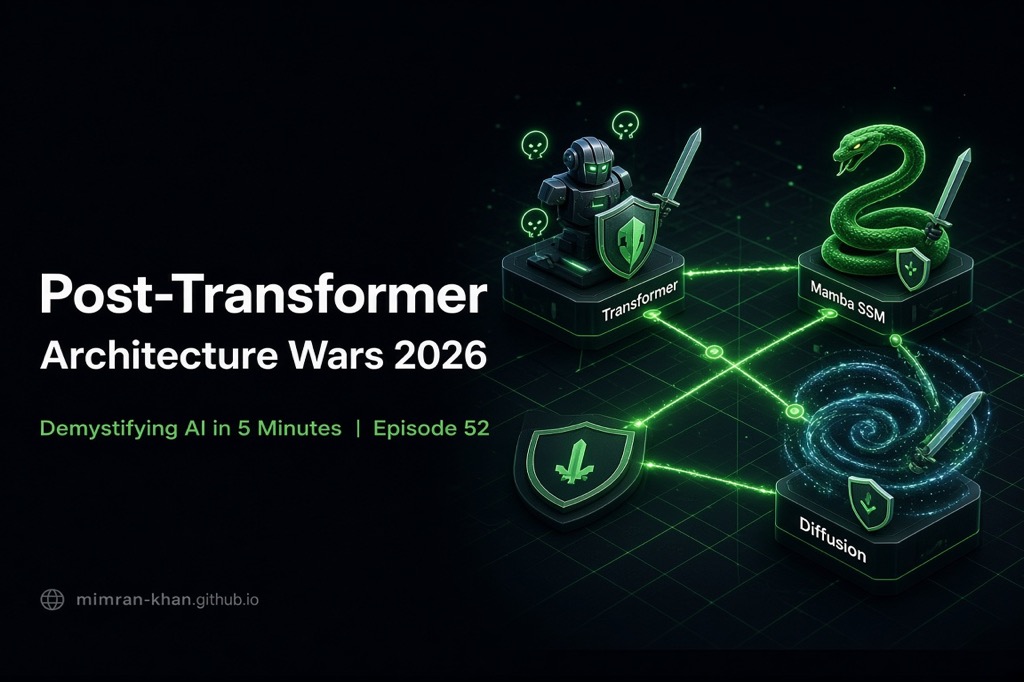
A viral r/MachineLearning post titled "Mapping Post-Transformer Architecture Landscape in 2026" sparked the debate that has been building all year. Four architecture families are now challenging the transformer: SSMs (Mamba, RWKV) with linear-time sequence processing, diffusion LLMs (Mercury 3) with parallel token generation, hybrid Mamba-Transformers (Nemotron 3.5, Jamba) that combine both paradigms, and linear attention models (TransNormerLLM). The current winner? Hybrids are dominating production benchmarks.
# The Transformer Monopoly Is Cracking
Since 2017, transformers have been the only architecture that matters. GPT, Claude, Gemini, Llama - all transformers. Every scaling law, every training recipe, every inference optimization has been built around self-attention.
But 2026 cracked that monopoly open. The evidence is now too strong to ignore: pure transformers are not the only path to state-of-the-art performance. Multiple production-grade models have shipped this year using fundamentally different architectures - and some of them are winning.
Self-attention computes relationships between every pair of tokens in the sequence. That means O(n²) compute and memory. Double the context length, quadruple the cost. At 128K tokens, you are spending most of your FLOPS on attention - not on actually understanding content. Every challenger architecture shares one goal: break the quadratic wall.
# The Four Contenders
The r/ML post mapped four distinct architecture families that have shipped production models in 2026. Each attacks the transformer's weaknesses from a different angle.
Process sequences in linear time O(n) using a fixed-size hidden state instead of computing all-pairs attention. Mamba introduced selective state spaces - the model dynamically chooses what to remember and what to forget, like a learned compression algorithm running over the sequence.
Generate all tokens in parallel through iterative denoising, like how image diffusion models work but applied to text. Mercury 3 (EP46) showed this can match autoregressive quality at 10x the throughput because you are not waiting for each token before generating the next one.
Stack Mamba layers for cheap long-range processing and sprinkle in attention layers where precise retrieval matters. Nemotron 3.5 (EP50) hit 51.78% on SWE-bench Pro with this recipe. AI21's Jamba uses the same hybrid approach. The key insight: you do not need attention everywhere, just where it counts.
Keep the attention mechanism but replace the softmax kernel with a linear approximation, reducing O(n²) to O(n). TransNormerLLM rewrites the attention equation so it can be computed as a running sum rather than a full matrix multiply. You keep attention's expressivity while getting SSM-like scaling.
# Why Hybrids Are Winning
The r/ML thread reached a rough consensus: pure alternatives are not ready to replace transformers, but hybrids already have. The reasoning comes down to two complementary strengths.
SSM layers compress long sequences into a fixed-size state efficiently. For tasks where you need to process 100K+ tokens of context - codebases, documents, agent trajectories - Mamba layers handle the bulk of the work at O(n) cost. This is where transformers bleed compute.
Attention layers are unbeatable at precise in-context learning: copy tasks, few-shot examples, exact recall from earlier in the conversation. Pure Mamba models fail at these tasks because their fixed-size state cannot perfectly preserve arbitrary tokens. A few attention layers solve this.
# Simplified hybrid Mamba-Transformer block pattern
# (conceptual, not exact implementation)

layers = [
    MambaBlock(),       # Long-range, O(n)
    MambaBlock(),       # Long-range, O(n)
    MambaBlock(),       # Long-range, O(n)
    AttentionBlock(),   # Precise retrieval, O(n²) but sparse
    MambaBlock(),       # Long-range, O(n)
    MambaBlock(),       # Long-range, O(n)
    MambaBlock(),       # Long-range, O(n)
    AttentionBlock(),   # Precise retrieval
]

# Result: ~75% of layers are O(n), ~25% are O(n²)
# Effective cost: much cheaper than full transformer
# Quality: matches or beats pure transformer
The ratio matters. Nemotron 3.5 and Jamba both use roughly 3:1 or 4:1 Mamba-to-attention ratios. That means 75-80% of layers run at linear cost. The attention layers handle the 20% of computation where precise token-level retrieval is critical. The result: transformer-quality outputs at a fraction of the compute. GGUF quantization (EP44) makes these hybrids even more deployable on consumer hardware.
# Where This Is Going
The r/ML discussion converged on one prediction: the future is mixture-of-architectures. Not one winner, but a toolbox.
Routing layers that choose the right architecture per token. Not just MoE (which selects experts within a transformer), but MoA - Mixture of Architectures. Some tokens route through Mamba for efficiency, others through attention for precision. The router learns which architecture each input needs.
Diffusion for batch generation, autoregressive for interactive. Mercury 3 showed that diffusion LLMs can generate entire responses in parallel at 10x throughput. The trade-off is latency control. Expect production systems that use diffusion for offline batch tasks and autoregressive models for real-time chat.
Hardware-specific architecture selection. Mamba's recurrent structure maps naturally to sequential processors and edge devices. Attention parallelizes across GPUs. Diffusion needs massive batch parallelism. The winning architecture may depend on where you are running it, not which benchmark you care about.
Training recipe convergence. The biggest barrier to non-transformer architectures was the lack of proven training recipes. Nemotron 3.5 and Jamba have now published reproducible hybrid training pipelines. Expect the ecosystem of tools, libraries, and best practices to follow rapidly in 2027.
The question "what replaces the transformer?" is the wrong question. The right question is: which combination of architectures gives you the best quality-per-FLOP for your specific workload? And 2026 finally gave us enough production evidence to start answering it.
The transformer is not dead, but its monopoly is. Mamba handles long context in linear time but struggles with retrieval. Attention is precise but quadratically expensive. Diffusion generates in parallel but sacrifices control. Hybrids like Nemotron 3.5 and Jamba combine Mamba and attention to beat pure transformers on quality, speed, and cost simultaneously. The post-transformer era is not about replacing attention - it is about using it only where it matters.
Enjoyed this?
New episodes Mon, Wed, Sat.